 Librería Samer Atenea
 Kálamo Books
 Librería Elías (Asturias)
 Librería Kolima (Madrid)
 Librería Proteo (Málaga)
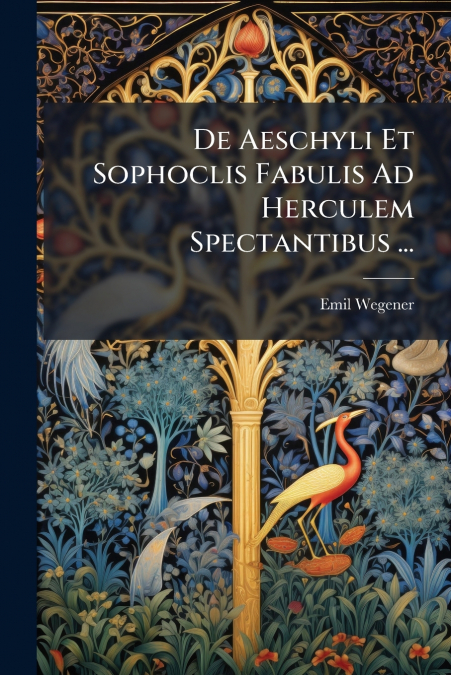
Cette étude approfondie, intitulée 'De Aeschyli Et Sophoclis Fabulis Ad Herculem Spectantibus', par Emil Wegener, explore les représentations d’Hercule dans les œuvres d’Eschyle et de Sophocle. Publiée en 1889, cette analyse détaillée offre un aperçu précieux des interprétations classiques du mythe d’Hercule dans le contexte du théâtre grec antique. Wegener examine avec minutie la manière dont ces dramaturges majeurs ont façonné et adapté les récits héroïques pour le public de leur époque. Ce travail érudit demeure une ressource essentielle pour les chercheurs et les étudiants intéressés par la littérature classique, la mythologie grecque et l’histoire du théâtre. Il met en lumière les subtilités des textes originaux et offre une perspective éclairée sur l’évolution des figures mythologiques à travers le temps. L’ouvrage, bien que datant de la fin du XIXe siècle, conserve toute sa pertinence pour comprendre les fondements de la culture occidentale et l’héritage durable de la Grèce antique.This work has been selected by scholars as being culturally important, and is part of the knowledge base of civilization as we know it. This work was reproduced from the original artifact, and remains as true to the original work as possible. Therefore, you will see the original copyright references, library stamps (as most of these works have been housed in our most important libraries around the world), and other notations in the work.This work is in the public domain in the United States of America, and possibly other nations. Within the United States, you may freely copy and distribute this work, as no entity (individual or corporate) has a copyright on the body of the work.As a reproduction of a historical artifact, this work may contain missing or blurred pages, poor pictures, errant marks, etc. Scholars believe, and we concur, that this work is important enough to be preserved, reproduced, and made generally available to the public. We appreciate your support of the preservation process, and thank you for being an important part of keeping this knowledge alive and relevant.