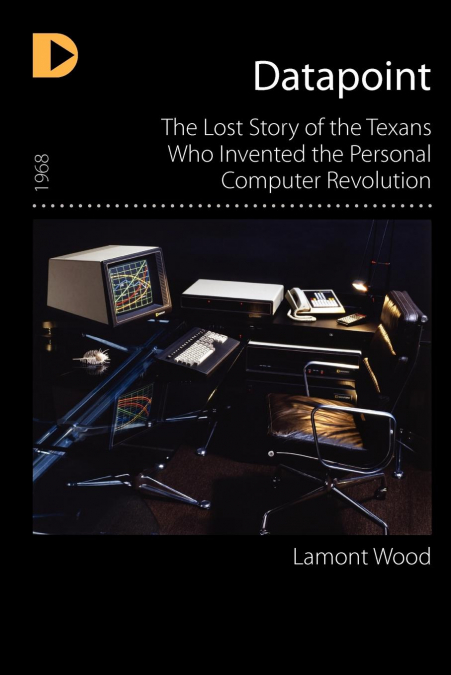

Datapoint

Datapoint

Datapoint

Lamont Wood

23,97 €
IVA incluido
Disponible
Editorial:
Hugo House Publishers
Año de edición:
2012
Materia
Historia de empresas específicas/historia societaria
ISBN:
9781936449361
23,97 €
IVA incluido
Disponible

Selecciona una librería:

  • Librería Samer Atenea
  • Librería Aciertas (Toledo)
  • Kálamo Books
  • Librería Perelló (Valencia)
  • Librería Elías (Asturias)
  • Donde los libros
  • Librería Kolima (Madrid)
  • Librería Proteo (Málaga)

Forget Apple and IBM. For that matter forget Silicon Valley. The first personal computer, a self-contained unit with its own programmable processor, display, keyboard, internal memory, telephone interface, and mass storage of data was born in San Antonio TX. US Patent number 224,415 was filed November 27, 1970 for a machine that is the direct lineal ancestor to the PC as we know it today. The story begins in 1968, when two Texans, Phil Ray and Gus Roche, founded a firm called Computer Terminal Corporation. As the name implies their first product was a Datapoint 3300 computer terminal replacement for a mechanical Teletype. However, they knew all the while that the 3300 was only a way to get started, and it was cover for what their real intentions were - to create a programmable mass-produced desktop computer. They brought in Jack Frassanito, Vic Poor, Jonathan Schmidt, Harry Pyle and a team of designers, engineers and programmers to create the Datapoint 2200. In an attempt to reduce the size and power requirement of the computer it became apparent that the 2200 processor could be printed on a silicon chip. Datapoint approached Intel who rejected the concept as a 'dumb idea' but were willing to try for a development contract. Intel belatedly came back with their chip but by then the Datapoint 2200 was already in production. Intel added the chip to its catalog designating it the 8008. A later upgrade, the 8080 formed the heart of the Altair and IMSI in the mid-seventies. With further development it was used in the first IBM PC-the PC revolution's chip dynasty. If you're using a PC, you're using a modernized Datapoint 2000.

Artículos relacionados

  • The Rise and Fall of H&H Bagels
    Marc Zirogiannis
    In September, 2015 President Barack Obama informed The Forward, in a historic interview, of his shock at learning of the closing of his favorite NYC Bagel eatery, H&H Bagels, in January of 2012. While the President was shocked by the closing of the world’s most famous, and recognizable, bagel brand, what was truly shocking were the underlying facts and circumstances surrounding...
  • Mr. Lee’s Publicity Book
    Ivy Ledbetter Lee
    This book, newly discovered from the archives of his biographer, is Ivy Lee’s only known full-length manuscript. Written in the mid-1920s, a time when the public relations field was first coming into its own, it is a guide not as much for the practitioner, but wisely, for a Jazz-Age public facing its first-ever bout of “information overload.” Lee advises the reader how to ident...
    Disponible

    47,29 €

  • Selling Creative - Advertising Men and Women in the Hall of Fame
    Mary E. Warlick
    Americans have long enjoyed a fascination with advertising, a complex love-hate relationship. Ads are often connected with childhood recollections of favorite brands and characters-whether they are annoying, entertaining or persuasive, and the messages often lodge in our memories long after the actual product has disappeared from our consciousness. 'Melts in Your Mouth, Not in ...
    Disponible

    42,35 €

  • Global Electrification
    Mira Wilkins / Peter Hertner / William J. Hausman / William JHausman
    ...
    Disponible

    70,50 €

  • Verse by the Side of the Road
    Frank Rowsome
    ...
    Disponible

    26,51 €

  • Corporate Control, Corporate Power
    Edward S. Herman / Edward SHerman
    ...
    Disponible

    63,37 €

Otros libros del autor

  • Datapoint
    Lamont Wood
    Forget Apple and IBM. For that matter forget Silicon Valley. The first personal computer, a self-contained unit with its own programmable processor, display, keyboard, internal memory, telephone interface, and mass storage of data was born in San Antonio TX. US Patent number 224,415 was filed November 27, 1970 for a machine that is the direct lineal ancestor to the PC as we kno...