 Librería Samer Atenea
 Kálamo Books
 Librería Elías (Asturias)
 Librería Kolima (Madrid)
 Librería Proteo (Málaga)
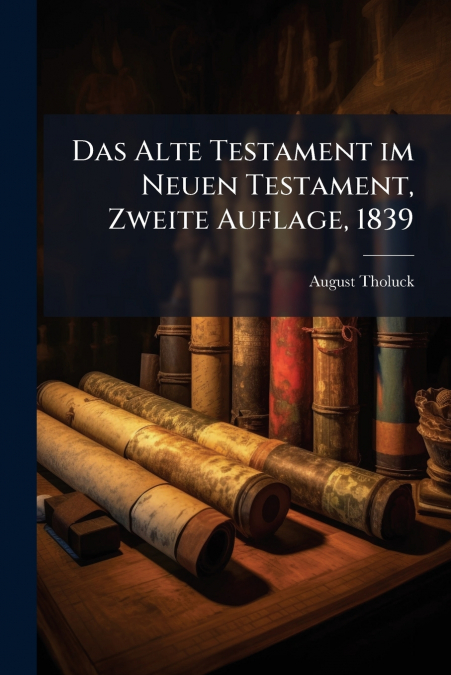
Das Alte Testament im Neuen Testament, Zweite Auflage (1839), by August Tholuck, explores the intricate relationship between the Old and New Testaments. Written in German, this theological work delves into the interpretation of Old Testament prophecies and their fulfillment in the New Testament. Tholuck provides a detailed analysis of key passages, offering insights into the continuity and development of religious thought. This second edition enhances the original text with further refinements and scholarly discourse, making it an invaluable resource for theologians, biblical scholars, and anyone interested in understanding the foundations of Christian belief. The book remains relevant for its historical and theological significance, providing a window into 19th-century biblical scholarship and its enduring impact on contemporary religious studies.This work has been selected by scholars as being culturally important, and is part of the knowledge base of civilization as we know it. This work was reproduced from the original artifact, and remains as true to the original work as possible. Therefore, you will see the original copyright references, library stamps (as most of these works have been housed in our most important libraries around the world), and other notations in the work.This work is in the public domain in the United States of America, and possibly other nations. Within the United States, you may freely copy and distribute this work, as no entity (individual or corporate) has a copyright on the body of the work.As a reproduction of a historical artifact, this work may contain missing or blurred pages, poor pictures, errant marks, etc. Scholars believe, and we concur, that this work is important enough to be preserved, reproduced, and made generally available to the public. We appreciate your support of the preservation process, and thank you for being an important part of keeping this knowledge alive and relevant.