
Inicio > Humanidades > Historia > Darwin’s Hunch
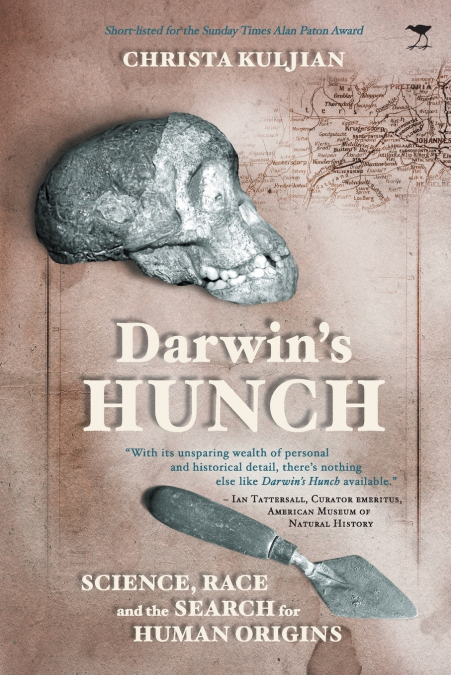
Darwin’s Hunch

Darwin’s Hunch

Christa Kuljian

28,34 €
IVA incluido
Disponible
Editorial:
Digital on Demand
Año de edición:
2016
Materia
Historia
ISBN:
9781431424252
28,34 €
IVA incluido
Disponible

Selecciona una librería:

  • Librería Samer Atenea
  • Librería Aciertas (Toledo)
  • Kálamo Books
  • Librería Perelló (Valencia)
  • Librería Elías (Asturias)
  • Donde los libros
  • Librería Kolima (Madrid)
  • Librería Proteo (Málaga)

The announcement of the Homo naledi hominid fossils by Professor Lee Berger in September 2015 at Maropeng outside Johannesburg dominated the news and headlines for months internationally. The public reaction to the find indicated a fascination in the search for human origins, and that the concept of race and human evolution are linked in many people’s minds.Christa Kuljian traces the history of South African palaeoanthropology and genetics research in order to make sense of science and race in the quest to understand human origins. Over time, the nature of the search has shifted and changed. What are we looking for after all?Darwin’s hunch in 1871 was that humans evolved in Africa, but very few European scientists agreed. Raymond Dart wrote in Nature in February 1925 that the Taung Child Skull supported Darwin’s theory. Dart believed he had found the 'missing link' between apes and humans. Again, few scientists agreed. Over the past century, the search for human origins has been shaped by the changing social and political context. Reflecting colonial thinking, Raymond Dart followed the practice in the US and Europe of collecting human remains and characterising human skeletons into racial types. He thought that there was a Bushman racial type that might provide a clue to human evolution. In 1936, he led a Wits University expedition to the Kalahari to study this imaginary racial type. One of the people he met and measured was a young woman named /Keri-/Keri. She died two years later. Her body was embalmed and taken to Wits University where her skeleton became part of the Raymond Dart Skeleton Collection. The book uncovers the sad story of what happened to her remains. In addition to /Keri-/Keri, Kuljian introduces us to a range of people who were in the shadows of the well-known scientists.The book shows how Prime Minister Jan Smuts supported the search for human origins in the 1920s, 30s and 40s, how the concept of human evolution was opposed by the apartheid government, and how the post-1994 South African government and President Thabo Mbeki, with encouragement from Phillip Tobias, celebrated the fact that Africa is the Cradle of Humankind. Yet the search continues. In 1987, the publication of ’Mitochondrial DNA and Human Evolution’ suggested that all living humans could trace their ancestry back to Africa 200,000 years ago. Many scientists and the general public in the West were slow to accept such a claim. Genetic research continues today, based not on fossils or skeletons, but on DNA samples. Kuljian examines current thinking and approaches to the ongoing search and explains why for much of the past century so many scientists were reluctant to accept Darwin’s Hunch.

Artículos relacionados

  • Raising Freedom's Banner
    Paul Harris
    World wide history of peaceful street demonstrations from their earliest beginning in eighteenth century England to their use throughout the world in the twenty-first century. Describes why some demonstration movements succeeded and others failed. Contrasts demonstrations within the law with civil disobedience demonstrations. Describes Peterloo, the Chartists, the Suffragettes,...
    Disponible

    23,59 €

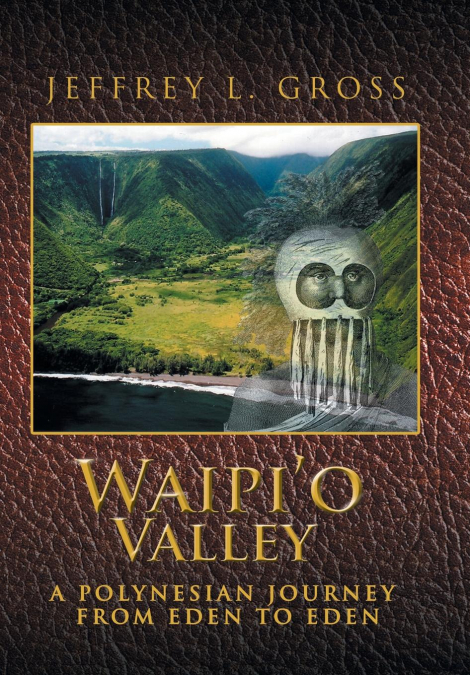
  • Waipi’o Valley
    Jeffrey L. Gross
    Waipi’o Valley: A Polynesian Journey from Eden to Eden recounts the remarkable migrations of the Polynesians across a third of the circumference of the earth. Their amazing journey began from Kalana i Hau’ola, the biblical “Garden of Eden” located along the shore of the Persian Gulf, extended to the Indus River Valley of ancient Vedic India, to Egypt where some ancestors of the...
  • Floralia
    June Rainsford Butler
    A century characterized by a growing interest in science, the opportunity for travel, and leisure for gardening furnishes the setting for Butler’s book. The rise of landscape gardening in England is traced, and the origin and history of its most famous gardens are given. The close relation between England and America in the field of horticulture is also discussed.Originally pub...
    Disponible

    61,20 €

  • President Wilson’s Addresses
    Woodrow Wilson
    'These addresses of President Woodrow Wilson are almost entirely concerned with political affairs, and more specifically with defining Americanism. Yet they also show that even as he moved from academia to the heights of politics, Wilson retained something of the teacher’s interest in showing the relation between specific instances and the general forms of thought or action of ...
  • The Story of my Life
    John Albert Macy
    The Story of My Life, is Helen Keller’s autobiography detailing her early life, especially her experiences with Anne Sullivan. The book is dedicated to inventor Alexander Graham Bell. The dedication reads, 'To ALEXANDER GRAHAM BELL Who has taught the deaf to speak and enabled the listening ear to hear speech from the Atlantic to the Rockies, I dedicate this Story of My Life.' ...
  • The Story of My Life Vol. 6 Spanish Passions
    Giacomo Casanova
    Casanova was an Italian adventurer and author from the Republic of Venice. His autobiography, Histoire de ma vie (Story of My Life), is regarded as one of the most authentic sources of the customs and norms of European social life during the 18th century. He has become so famous for his often complicated and elaborate affairs with women that his name is now synonymous with 'wom...