

 Librería Samer Atenea
 Kálamo Books
 Librería Elías (Asturias)
 Librería Kolima (Madrid)
 Librería Proteo (Málaga)
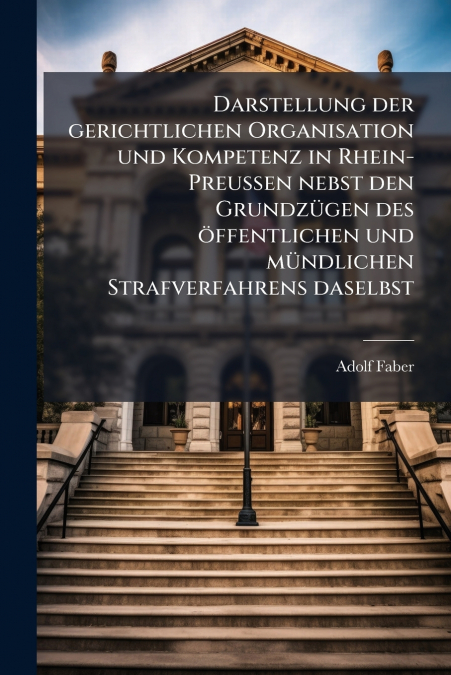
Darstellung der gerichtlichen Organisation und Kompetenz in Rhein-Preußen nebst den Grundzügen des öffentlichen und mündlichen Strafverfahrens daselbst, written by Adolf Faber, provides a detailed exposition of the judicial organization and competence within Rhine-Prussia. The book outlines the fundamentals of public and oral criminal proceedings as they were practiced in the region.This historical legal text offers valuable insights into the structure and operation of the Prussian court system, detailing the roles and responsibilities of various judicial bodies. It elucidates the processes involved in criminal trials, shedding light on the legal practices and procedures prevalent in Rhine-Prussia during the period of its writing. As such, this work is an essential resource for legal historians, scholars of German history, and anyone interested in understanding the evolution of legal systems in Europe.This work has been selected by scholars as being culturally important, and is part of the knowledge base of civilization as we know it. This work was reproduced from the original artifact, and remains as true to the original work as possible. Therefore, you will see the original copyright references, library stamps (as most of these works have been housed in our most important libraries around the world), and other notations in the work.This work is in the public domain in the United States of America, and possibly other nations. Within the United States, you may freely copy and distribute this work, as no entity (individual or corporate) has a copyright on the body of the work.As a reproduction of a historical artifact, this work may contain missing or blurred pages, poor pictures, errant marks, etc. Scholars believe, and we concur, that this work is important enough to be preserved, reproduced, and made generally available to the public. We appreciate your support of the preservation process, and thank you for being an important part of keeping this knowledge alive and relevant.





