

 Librería Samer Atenea
 Kálamo Books
 Librería Elías (Asturias)
 Librería Kolima (Madrid)
 Librería Proteo (Málaga)
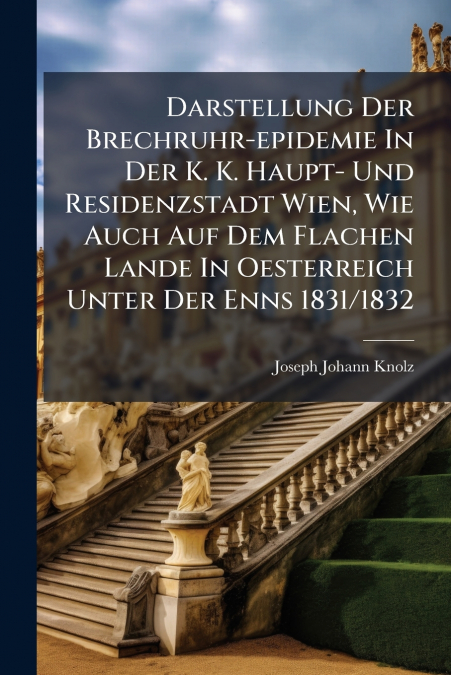
'Darstellung Der Brechruhr-epidemie In Der K. K. Haupt- Und Residenzstadt Wien, Wie Auch Auf Dem Flachen Lande In Oesterreich Unter Der Enns 1831/1832' meticulously chronicles the cholera epidemic that swept through Vienna and the surrounding Austrian countryside in 1831 and 1832. Authored by Joseph Johann Knolz, this historical account offers invaluable insights into the public health crisis, documenting its progression, impact, and the measures taken to combat the disease. This book serves as a crucial historical record for understanding the social, medical, and scientific contexts of 19th-century Europe. It provides a detailed snapshot of the challenges faced by communities grappling with a deadly epidemic and the strategies employed to mitigate its spread. Scholars of medical history, European history, and public health will find this work an indispensable resource for comprehending the complexities of disease outbreaks and their profound effects on society.This work has been selected by scholars as being culturally important, and is part of the knowledge base of civilization as we know it. This work was reproduced from the original artifact, and remains as true to the original work as possible. Therefore, you will see the original copyright references, library stamps (as most of these works have been housed in our most important libraries around the world), and other notations in the work.This work is in the public domain in the United States of America, and possibly other nations. Within the United States, you may freely copy and distribute this work, as no entity (individual or corporate) has a copyright on the body of the work.As a reproduction of a historical artifact, this work may contain missing or blurred pages, poor pictures, errant marks, etc. Scholars believe, and we concur, that this work is important enough to be preserved, reproduced, and made generally available to the public. We appreciate your support of the preservation process, and thank you for being an important part of keeping this knowledge alive and relevant.





