 Librería Samer Atenea
 Kálamo Books
 Librería Elías (Asturias)
 Librería Kolima (Madrid)
 Librería Proteo (Málaga)
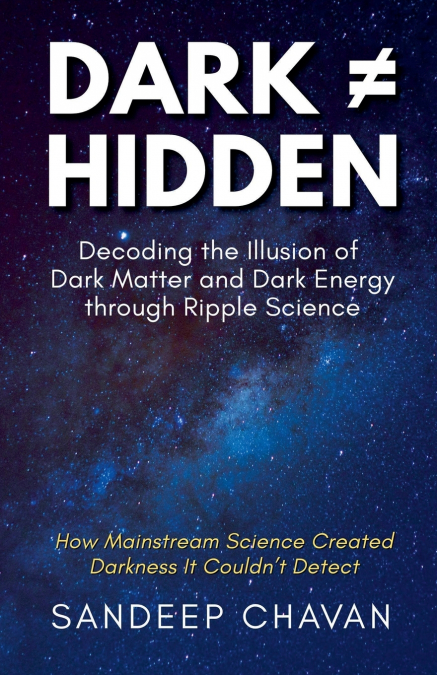
Dark ≠ HiddenWhat if the universe wasn’t withholding secrets-but we were just asking the wrong questions?For decades, physicists have been chasing shadows-'dark matter,' 'dark energy,' and other invisible scaffolds-patching holes in models with concepts no telescope has ever truly confirmed. But what if the problem isn’t what’s missing... it’s how we’ve been looking?In Dark ≠ Hidden, Sandeep Chavan-engineer, philosopher, and creator of the Universal Energy Dynamics (UED) framework-delivers a powerful alternative to the tired paradigms of modern physics. Rather than inventing unseeable particles or bending spacetime to fit data, Chavan introduces a field-aligned cosmos where every consequence is measurable, every ripple has memory, and nothing is truly dark-only misinterpreted.Drawing from years of independent research and a bold critique of mainstream science, Chavan dismantles the myth of the 'unknown' with precision and clarity. He offers fresh interpretations of:Flat galaxy rotation curves-without invoking dark matter halosRedshift anomalies-as ripple fatigue, not cosmic accelerationGravitational lensing-explained by structured field memory, not exotic massVoid dynamics, cosmic flows, and high-z galaxies-through ripple alignment and entropy responseAt the heart of this book lies a simple but revolutionary idea:'You didn’t fail to find it. You failed to ask what you were really seeing.'UED proposes a new physics rooted in ripple response, Alignment Threshold Time (ATT), and Ripple Delay Index (RDI)-measurable, testable, and observable tools that turn silence into signal and mystery into meaning. It’s not a rejection of science. It’s a return to what science always promised: truth, without assumption.Written for researchers, thinkers, skeptics, and those exhausted by metaphysical placeholders, Dark ≠ Hidden is a declaration of intellectual freedom. It’s an invitation to realign our instruments, our vocabulary, and most importantly-our curiosity.