

Erik de Boisgrollier / Simon Maillard
 Librería Samer Atenea
 Kálamo Books
 Librería Elías (Asturias)
 Librería Kolima (Madrid)
 Librería Proteo (Málaga)
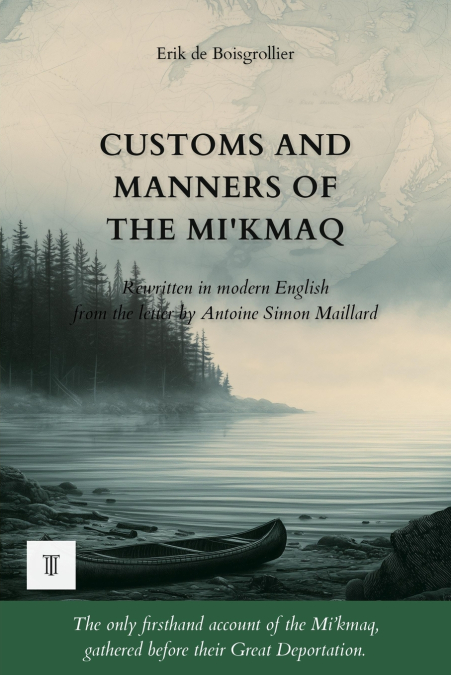
Île Royale, around 1755. For twenty years, a French priest has lived among the Mi’kmaq, speaking their language better than any European before him, and watching the end of a world approach. Before everything gives way, he writes.What Antoine Simon Maillard recounts to his superior in Paris, no one else has seen. The old jongleur Arguimant describing the sacred fire, the skin canoes, and the monstrous fish of the time before ships. The eau-de-vie brought from France, and what it does to men. Warriors leaving to defend Louisbourg while the women mourn before the shuttered church. The wounded of Lorembec returning by night, and the chief René hidden beneath the moss while the English pass. An enemy officer attending Mass, discussing faith with the leader of the Prayer, unaware that he has been recognized.Maillard admires this people and judges them, loves them and despairs of them, and loses his temper before the assembled mission. He invents for them a system of signs that the women copy onto birch bark. Then, one evening, he sets down his pen in the middle of a sentence and never picks it up again.The text met an unusual fate. As early as 1758, English-speaking readers had access only to an abridged version published in London, reduced to a quarter of Maillard’s original text, into which the London editor had inserted notes hostile to Catholicism in the very midst of the missionary’s own sentences. The complete French text, meanwhile, was published only once, in Quebec in 1863, in Les Soirées canadiennes, from the autograph manuscript, and has never been reprinted since. The present edition offers its first complete translation into English.Written as Louisbourg lived out its final years and the deportation of the Acadians began, this letter is a firsthand account gathered on the brink of upheaval, on the eve of the dispersal of the very people it describes. Maillard, the first Frenchman to master the Mi’kmaq language, also perfects in it a system of signs devised for this people, which the women of the mission copy and teach one another on birch bark.Complete rewriting in modern English of the letter: 'Lettre sur les missions de l’Acadie et particulièrement sur les missions micmaques' by Antoine Simon Maillard, 1755, including maps and illustrations.





