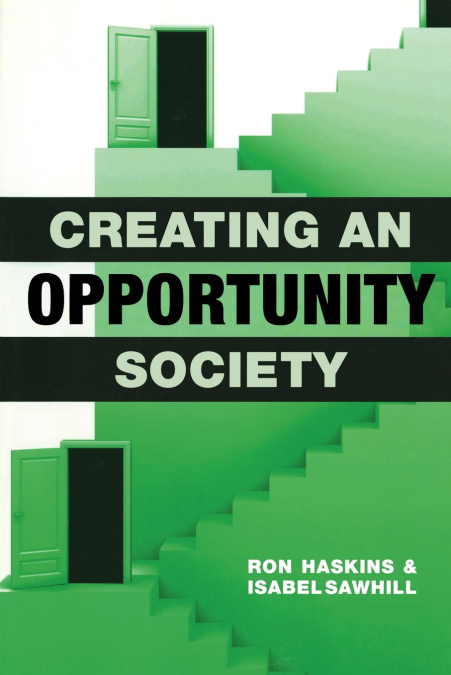
Creating an Opportunity Society

Creating an Opportunity Society

Isabel V. Sawhill / Ron Haskins

44,27 €
IVA incluido
Disponible
Editorial:
Bloomsbury Publishing plc
Año de edición:
2009
Materia
Macroeconomía
ISBN:
9780815703228
44,27 €
IVA incluido
Disponible

Selecciona una librería:

  • Librería Samer Atenea
  • Librería Aciertas (Toledo)
  • Kálamo Books
  • Librería Perelló (Valencia)
  • Librería Elías (Asturias)
  • Donde los libros
  • Librería Kolima (Madrid)
  • Librería Proteo (Málaga)

'Americans believe economic opportunity is as fundamental a right as life, liberty, and the pursuit of happiness. More concerned about a level playing field for all, they worry less about the growing income and wealth disparity in our country. Creating an Opportunity Society examines economic opportunity in the United States and explores how to create more of it, particularly for those on the bottom rungs of the economic ladder.Ron Haskins and Isabel Sawhill propose a concrete agenda for increasing opportunity that is cost effective, consistent with American values, and focuses on improving the lives of the young and the disadvantaged. They emphasize individual responsibility as an indispensable basis for successful policies and programs.The authors recommend a three-pronged approach to create more opportunity in America:• Increase education for children and youth at the preschool, K-12, and postsecondary levels• Encourage and support work among adults• Reduce the number of out-of-wedlock births while increasing the share of children reared by their married parentsWith concern for the federal deficit in mind, Haskins and Sawhill argue for reallocating existing resources, especially from the affluent elderly to disadvantaged children and their families. The authors are optimistic that a judicious use of the nation's resources can level the playing field and produce more opportunity for all.Creating an Opportunity Society offers the most complete summary available of the facts and the factors that contribute to economic opportunity. It looks at the poor, the middle class, and the rich, providing deep background data on how each group has fared in recent decades. Unfortunately, only the rich have made substantial progress, making this book a timely guide forward for anyone interested in what we can do as a society to improve the prospects for our less-advantaged families and fellow citizens.'
Artículos relacionados

  • Introduction to Dynamic Macroeconomic General Equilibrium Models
    José Luis Torres Chacon
    This book offers an introductory step-by-step course in Dynamic Stochastic General Equilibrium modelling. Modern macroeconomic analysis is increasingly concerned with the construction, calibration and/or estimation and simulation of Dynamic General Equilibrium (DGE) models. The book is intended for graduate students as an introductory course to DGE modelling and for those econo...
    Disponible

    61,40 €

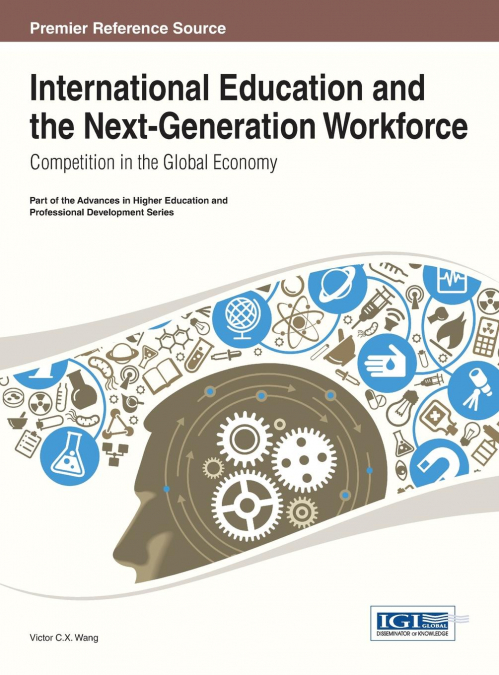
  • International Education and the Next-Generation Workforce
    Wei Wang
    Education is the first stage in developing a viable, dynamic, and long-lived global economy. Unfortunately, in times of economic hardship, educational programs, teacher salaries, and extracurricular opportunities are often the first to be cut. International Education and the Next-Generation Workforce: Competition in the Global Economy presents a detailed discussion of present e...
  • Macroeconomic Policies of Developed Democracies
    Robert J Franzese Jr
    ...
  • End Of The Road
    Louis Holder
    This book is about the mismanagement of Western economies in pursuit of political power, which resulting devastation will have to be borne by future generations. The book establishes that postponement is no longer doable and lays out the hard choices ahead causing much misery and agony.Although not fully recognized because of masking by asset bubbles, which are spun/sold as in...
    Disponible

    16,42 €

  • The Darwin Economy
    Robert H. Frank
    What Charles Darwin can teach us about building a fairer societyWho was the greater economist-Adam Smith or Charles Darwin? The question seems absurd. Darwin, after all, was a naturalist, not an economist. But Robert Frank, New York Times economics columnist and best-selling author of The Economic Naturalist, predicts that within the next century Darwin will unseat Smith as the...
    Disponible

    22,42 €

  • Myth and Measurement
    Alan B. Krueger / David Card
    From David Card, winner of the Nobel Prize in Economics, and Alan Krueger, a provocative challenge to conventional wisdom about the minimum wageDavid Card and Alan B. Krueger have already made national news with their pathbreaking research on the minimum wage. Here they present a powerful new challenge to the conventional view that higher minimum wages reduce jobs for low-wage ...
    Disponible

    39,64 €