
Corn Crusade

Corn Crusade

Aaron T. Hale-Dorrell

147,32 €
IVA incluido
Consulta disponibilidad
Editorial:
Oxford University Press
Año de edición:
2018
Materia
Historia de otras regiones
ISBN:
9780190644673

Selecciona una librería:

  • Librería Samer Atenea
  • Librería Aciertas (Toledo)
  • Kálamo Books
  • Librería Perelló (Valencia)
  • Librería Elías (Asturias)
  • Donde los libros
  • Librería Kolima (Madrid)
  • Librería Proteo (Málaga)

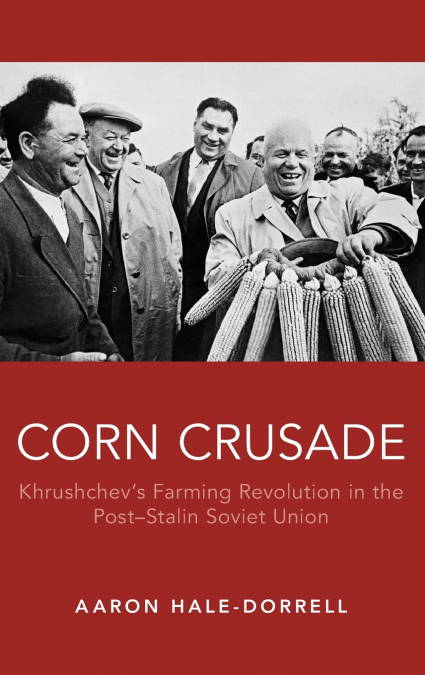
Corn Crusade: Khrushchev’s Farming Revolution in the Post-Stalin Soviet Union is the first history of Nikita Khrushchev’s venture to cover the Soviet Union in corn, a crop common globally but hitherto rare in his country. Lasting from 1953 until 1964, this crusade was an emblematic component of his efforts to resolve agrarian crises inherited from Joseph Stalin. Using policies and propaganda to pressure farms to expand corn plantings tenfold, Khrushchev expected the resulting bounty to feed not people, but the livestock necessary to produce the meat and dairy products required to make good on his frequent pledges that the Soviet Union was soon to 'catch up to and surpass America.' This promised to enrich citizens’ hitherto monotonous diets and score a victory in the Cold War, which was partly recast as a 'peaceful competition' between communism and capitalism. Khrushchev’s former comrades derided corn as one of his 'harebrained schemes' when ousting him in October 1964. Echoing them, scholars have ridiculed it as an 'irrational obsession,' blaming the failure on climatic conditions. Corn Crusade brings a more complex and revealing history to light. Borrowing technologies from the United States, Khrushchev expected farms in the Soviet Union to increase productivity because he believed that innovations developed under capitalism promised greater returns under socialism. These technologies generated results in many economic, social, and climatic contexts after World War II but fell short in the Soviet Union. Attempting to make agriculture more productive and ameliorate exploitative labor practices established in the 1930s, Khrushchev achieved only partial reform of rural economic life. Enjoying authority over formal policy, Khrushchev stood atop an undisciplined hierarchy of bureaucracies, local authorities, and farmworkers. Weighing competing incentives, they flouted his authority by doing enough to avoid penalties, but too little to produce even modest harvests of corn, let alone the bumper crops the leader envisioned.


Artículos relacionados

  • Negotiating the NWT Devolution of Lands & Resources
    Hal J. Gerein / Hal JGerein
    In this story, the author is the GNWT's Chief Negotiator for the devolution of lands and resources from Canada. Devolution means the transfer of authority from a senior level of government to a junior level. Many national governments today areinvolved with devolution as a means to "subsidiarity", the principle that politicalpower should be exercised by the least central or ...
    Disponible

    44,75 €

  • 'THE TRIPLE WHAMMY' AND OTHER RUSSIAN STORIES
    Louis Menashe
    A captivating lifetime of personal and professional experiences by an American historian, film specialist and documentary filmmaker in the Soviet Union and post-Soviet Russia. The author’s experiences as a radical in the turbulent 1960s, and his eventual disenchantment offer some precedents and perspectives to all those on the Left, Center or Right interested in the fluctuation...
    Disponible

    26,31 €

  • In Defence of Lenin
    Alan Woods / Rob Sewell
    John Reed, the author of Ten Days that Shook the World, once said that Lenin was the most loved and the most hated person alive. He was loved by tens of millions who wanted to change society, but hated by the ruling class and their apologists.As the creator of the Bolshevik Party and leader of the Russian Revolution, Lenin was a man who changed the world and translated the idea...
    Disponible

    23,85 €

  • The peoples of Ancient Siberia
    Aleksei P Okladnikov / Richard L Bland
    Foreword: Elena A. Okladnikova, Herzen University, St. Petersburg (Russia), Deputy Director for Museum Work at the Peter the Great Museum of Anthropology and Ethnography (Kunstkamera)Translators: Richard L. Bland, Archeologist (retired), U.S. National Park Service, Heritage Research Associates, University of Oregon Museum of Natural and Cultural History; Yaroslav V. Kuzmin, Ins...
  • The Oldest Art of Siberia
    Liudmila V Lbova / Pavel V Volkov / Richard L Bland
    Primitive art is inseparable from primitive consciousness and can be correctly understood only with the correct socio-cultural context. This book examines the ancient art of Siberia as part of the integral whole of ancient society. ...
  • The Depths of Russia
    Douglas Rogers / Polina Shubina
    In The Depths of Russia, Yale anthropologist and historian Douglas Rogers tells the history of Russian oil from the perspective of the Perm region of the Urals. From the discovery of world’s first socialist oil in 1929 to the oil-fueled social and cultural politics of the 2000s, he shows how Permian oil illuminates the place of oil in the modern world in new ways. Rogers pays p...