 Librería Samer Atenea
 Kálamo Books
 Librería Elías (Asturias)
 Librería Kolima (Madrid)
 Librería Proteo (Málaga)
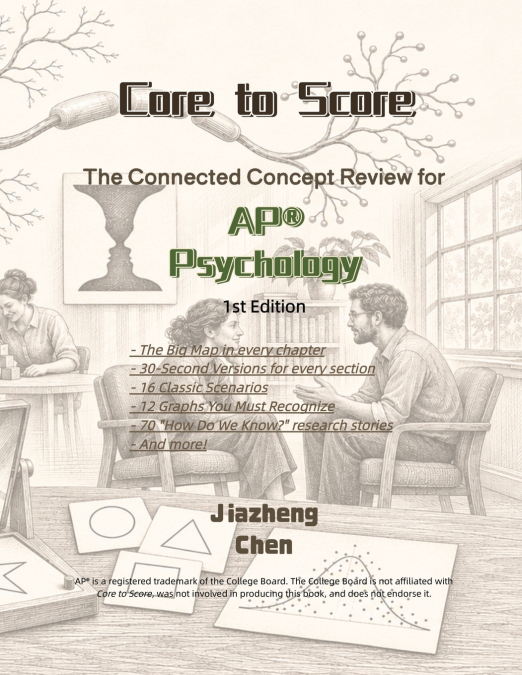
AP® Psychology rewards students who can connect ideas, not just define them. The exam describes a person, a situation, or a study and asks which concept applies, how different perspectives would explain it, and what the research can and can’t show. Core to Score: The Connected Concept Review for AP® Psychology is built for exactly that kind of thinking.This book covers every topic in the current AP Psychology Course and Exam Description, unit by unit, in five chapters: Biological Bases of Behavior; Cognition; Development and Learning; Social Psychology and Personality; and Mental and Physical Health. But it never lets a topic stand alone. Each chapter opens with the Big Map, a single picture of the whole course that shows where you are and which arrows connect this chapter to the others. Each section begins with a 30-second summary you can review the night before the exam, then explains the ideas step by step, starting from what you already know and stopping to point out where students usually go wrong.Two questions run through every section. The first is 'One behavior, many perspectives': why a teenager can’t fall asleep until after midnight, why people eat more at a party, or why a fear of dogs persists is explained from the biological, behavioral, cognitive, sociocultural, and developmental perspectives, showing how the explanations fit together. The second is 'How do we know?': the classic studies of psychology, from Pavlov and Piaget to Asch, Milgram, and Bandura, are told the way they happened, including their limitations, ethical problems, and replication failures, so you can evaluate research the way the exam asks you to.Inside you’ll find:Must Know paragraphs that state the tested core of each topic, with Good to Know and Beyond the Exam material clearly labeled, including the content the course explicitly leaves out.Original black-and-white diagrams and graphs, from the neuron and the brain to reinforcement schedules, attachment, and the general adaptation syndrome.Common Misconception, Watch the Wording, Word Roots, and On the Exam boxes that target the errors and term confusions that cost students points.Quick Recall questions after every section, a Cumulative Check after every chapter with spaced review of earlier chapters, and original Classic Scenarios, including fictional practice studies, that ask you to identify methods, variables, conclusions, limitations, and ethical issues.Research Methods at a Glance, a one-stop guide to research designs, research terms, and the statistics you must read on the exam (mean, median, standard deviation, percentile rank, correlation, statistical significance, and effect size).Graphs You Must Recognize, a gallery of the twelve graphs that appear again and again on the exam.Key Terms, People, and Studies You Must Know, a chapter-by-chapter list of the researchers and studies the course names.A guide to the fully digital exam, including the Article Analysis Question and the Evidence-Based Question, and complete answers to every question in the book.Sensitive topics, including psychological disorders, stress, and trauma, are treated accurately and respectfully, using current diagnostic names and person-first language.Use it as a course companion, as an eight-to-ten-week exam review, as a last-month sprint, or as a reference while you practice. Core to Score is a concept review; for exam-style practice, it pairs with the companion books in the Practice to Mastery series.AP® and Advanced Placement® are registered trademarks of the College Board, which was not involved in the production of, and does not endorse, this product.