
Inicio > Humanidades > Historia > Historia regional y nacional > Historia de África > Contradictions in Post-War Education Policy Formation and Application in Colonial Malawi 1945-1961
Contradictions in Post-War Education Policy Formation and Application in Colonial Malawi 1945-1961

Contradictions in Post-War Education Policy Formation and Application in Colonial Malawi 1945-1961

Isaac Chikwekwere Lamba

82,60 €
IVA incluido
Disponible
Editorial:
African Books Collective
Año de edición:
2010
Materia
Historia de África
ISBN:
9789990887945
82,60 €
IVA incluido
Disponible

Selecciona una librería:

  • Librería Samer Atenea
  • Librería Aciertas (Toledo)
  • Kálamo Books
  • Librería Perelló (Valencia)
  • Librería Elías (Asturias)
  • Donde los libros
  • Librería Kolima (Madrid)
  • Librería Proteo (Málaga)

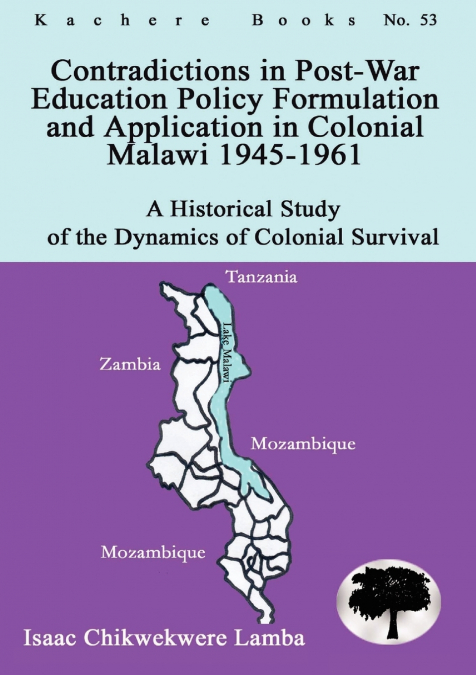
The post-World War II colonial reconstruction programmes for economic recovery and general political and social development in Malawi (then known as Nyasaland) necessitated increased education. But the sincerity of metropolitan development plans for the colonies could only be adequately appraised through the degree of demonstrated commitment in the implementation of the announced plans. This study seeks to examine chronologically the development and application of colonial education policies during the period 1945 to 1961 in Malawi. The parties involved included the British Colonial Office, the Nyasaland Protectorate Government and the Christian missionaries on the one hand, and the European settlers, Asian, Coloured and African communities on the other as the target groups of the policies. Devising educational policies of equitable benefit to all the racial and social groupings in Malawi posed enormous problems to the colonial administration. This study, examining the dynamics and course of policy, contends that, given the prevailing economic and political conditions, non-European education, especially that of Africans, experienced retardation in favour of European education. Sometimes apparent government ineptitude, combined with calculated needs for the Europeans, produced under-development for African education in Malawi and the country’s economy. In the end, African education operated against the odds of missionary and government apathy. This book discusses the impact on education, generally, of the Nyasaland Post-War Development Programme, the Colonial Office Commissions of 1947, 1951 and 1961, and the local Committees set up to inquire into the retardation of African education in its various categories, including female and Muslim, in response to both local and international pressure. Although considered a priority, African education developed slowly, contrary to the declared goal of Post-War colonial policy of self- determination with its potential demands for trained local manpower. The argument demonstrates the tenacity of the Federal Government of Rhodesia and Nyasaland in playing down African education as a political strategy from 1953 to 1961 at the same time as it accorded a better deal to Asian and Coloured education.
Artículos relacionados

  • Kulubnarti I
    William Y. Adams / William YAdams
    Sudan Archaeological Research Society. Publication Number 18In 1998 and 1999 volumes II and III of the reports on the University of Kentucky excavations at Kulubnarti were published by the Sudan Archaeological Research Society as numbers 2 and 4 in its monograph series. Kulubnarti III was also available through British Archaeological Reports in its International Series no. 814....
    Disponible

    104,23 €

  • The Creole Elite and the Rise of Angolan Protonationalism
    Jacopo Corrado
    This book is about Angolan literature and culture. It investigates a segment of Angolan history and literature, with which even Portuguese-speaking readers are generally not familiar. Its main purpose is to define the features and the literary production of the so-called ’creole elite’, as well as its contribution to the early manifestations of dissatisfaction towards colonial ...
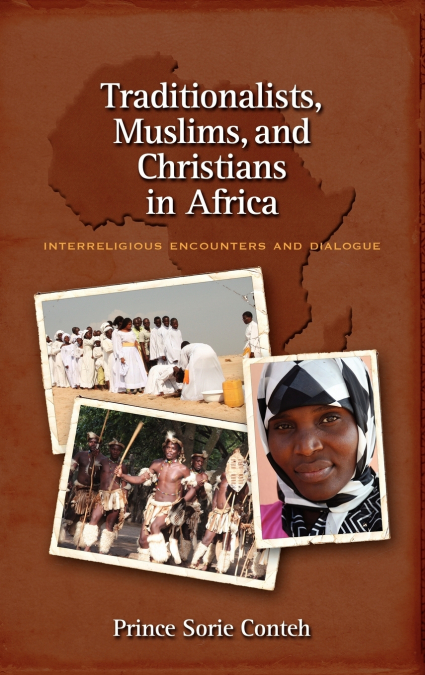
  • Traditionalists, Muslims, and Christians in Africa
    Prince Sorie Conteh
    As is the case for most of sub-Saharan Africa, African Traditional Religion (ATR) is the indigenous religion of Sierra Leone. When the early forebears and later progenitors of Islam and Christianity arrived, they met Sierra Leone indigenes with a remarkable knowledge of God and a structured religious system. Successive Muslim clerics, traders, and missionaries were respectful o...
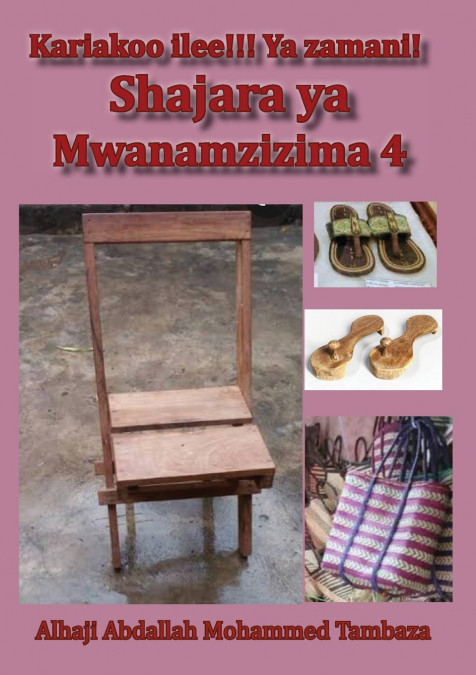
  • Shajara ya Mwana Mzizima 4
    Alhaji Abdallah Mohammed Tambaza
    This is the fourth part in the series of the history of Dar es salaam. This book is about Kariakoo, the first area where Africans were allowed to live and stay. It traces the history of the area before independence and up till the 1970’s.Kitabu hiki ni mfululizo wa vitabu vya kumbukumbu ya sehemu na watu mashuhuri katika jiji la Dar es Salaam. Kitabu hiki ni cha tatu ambacho ki...
    Disponible

    41,51 €

  • Britain, the Royal Air Force and relief flights to Biafra, 1968-1969
    Onianwa Oluchukwu Ignatus
    In this intriguing new book, Onianwa Oluchukwu Ignatus investigates Britain’s decision to engage the Royal Air Force (RAF) in the relief operations during the Nigerian Civil War. The main area badly ravaged by the conflict being the Republic of Biafra was declared 'a frontier of need.' Humanitarian concerns and mounting public pressures, both in Britain and other Western countr...
  • We Rest Here Content
    Robin Smith
    We Rest Here Content is not the history of the Imperial Light Horse Regiment - that was written by the regiment’s Intelligence Officer, Lieutenant George Fleming Gibson and published in 1937 as The Story of the Imperial Light Horse in the South African War 1899-1902. We Rest Here Content approaches the subject of the I.L.H. from a different viewpoint. It looks at all the known ...
    Disponible

    75,50 €