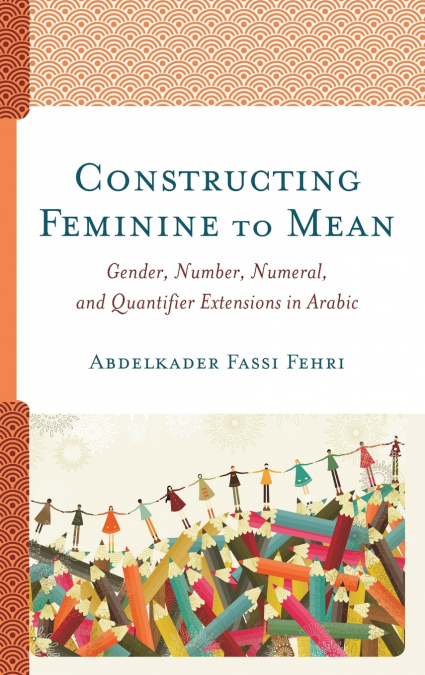

Constructing Feminine to Mean

Constructing Feminine to Mean

Constructing Feminine to Mean

Abdelkader Fassi Fehri

128,93 €
IVA incluido
Consulta disponibilidad
Editorial:
Bloomsbury Publishing plc
Año de edición:
2018
Materia
Lingüística histórica y comparada
ISBN:
9781498574556

Selecciona una librería:

  • Librería Samer Atenea
  • Librería Aciertas (Toledo)
  • Kálamo Books
  • Librería Perelló (Valencia)
  • Librería Elías (Asturias)
  • Donde los libros
  • Librería Kolima (Madrid)
  • Librería Proteo (Málaga)

Linguistic gender is a complex and amazing category that has puzzled and still puzzles theoretical linguists, typologists, philosophers, cognitive scientists, didacticians, as well as scholars of anthropology, culture, and even mystical (divine) sufism. In Standard and colloquial Arabic varieties, feminine morphology (unlike “common sense”) is not dedicated to mark beings of the female sex (or “natural gender”). When you name the female of a “lion” (ʔasad) or a “donkey” (ḥimaar), you use different words (labuʔat or ʔataan), as if the male and female of the same species are linguistically conceived as completely unrelated entities. When you “feminize” words like “bee” (naḥl) or “pigeon” (ḥamaam), the outcome is not a noun for the animal with a different sex, but a singular of the collective “bees,” “one bee” (naḥl-at), or an individual pigeon (ḥamaam-at). In the opposite direction, when a singular noun “carpenter” (najjar) is feminized, the (unexpected) result is a special plural, or rather a group, “carpenters as a professional group” (najjar-at). Since some of these words (contrastively) possess “normal” masculine plurals, or masculine singulars, I propose to distinguish atomicities (which are broadly “masculine”) from unities (which are “feminine”). The diversity of feminine senses is also manifested when you feminize an inherently masculine noun like “father” (ʔab), “uncle” (ʕamm), etc. The outcome (in the appropriate performative context) is that you are endearing your father or uncle, rather than “womanizing” him. More “unorthodox” senses are evaluative, pejorative, diminutive, augmentative, etc. It is striking that gender not only plays a central role in shaping individuation, or perspectizing plurality, but it is also used to distinguish what we count, or what we quantifier over. In Arabic, when you count numbers in sequence (three, four, five, six, etc.), you use the feminine, but when you count objects, you have to “negotiate” for gender, due to the “gender polarity” constraint. Your quantifier senses, which are also subtly built in the grammar, equally negotiate for gender. Wide cross-linguistic comparison extends the inventories of features, mechanisms, and typological notions used, to languages like Hebrew, Berber, Celtic, Germanic, Romance, Amazonian, etc. On the whole, gender is far from being parasitic in the grammar of Arabic or any language (including “classifier” languages). It is central as it has never been.
Artículos relacionados

  • The Language of Separation - Nationalism’s Impact on Linguistic Diversity
    PS Publishing
    'The Language of Separation' delves into the intricate relationship between nationalism and linguistic diversity. Exploring the impact of nationalist ideologies on language policies and practices, this book examines how notions of nationhood influence linguistic identity and representation. Through compelling analysis , it sheds light on the complexities of language politics an...
    Disponible

    14,22 €

  • Syntactic Change in Late Modern English
    Erik Smitterberg
    ...
    Disponible

    38,10 €

  • Third Factors in Language Variation and Change
    Elly Van Gelderen
    ...
    Disponible

    35,80 €

  • Interfaces and Domains of Contact-Driven Restructuring
    Sandro Sessarego
    ...
    Disponible

    36,03 €

  • New Horizons in Prescriptivism Research
    This book investigates the connections between evaluative judgements on language and the larger social, cultural, and political issues that shed light on the practice of prescriptivism. The chapters cover three main areas: language, which represents the traditional roots of the study of linguistic norms in authoritative (historical) manuals and judgemental attitudes to language...
  • How Yoruba and Igbo Became Different Languages
    Bolaji Aremo
    The main objective of this study is to identify examples of genetically related Igbo and Yoruba words that might serve as further evidence in support of some linguists’ claim that the two languages developed from the same parent language. The author is a retired head of the Department of English at Obafemi Awolowo University, Nigeria. ...
    Disponible

    53,75 €

Otros libros del autor

  • Issues in the Structure of Arabic Clauses and Words
    Abdelkader Fassi Fehri
    This study has a twofold goal. First, it investigates the internal structure of words and clauses in Standard Arabic (SA), in the light of recent developments of Government and Binding Theory (GB). Second, it argues for a specific theory of typology, and proposes a particular view of how parametrization can be construed and executed. SA is a language ...
    Disponible

    207,48 €

  • Issues in the Structure of Arabic Clauses and Words
    Abdelkader Fassi Fehri
    This study has a twofold goal. First, it investigates the internal structure of words and clauses in Standard Arabic (SA), in the light of recent developments of Government and Binding Theory (GB). Second, it argues for a specific theory of typology, and proposes a particular view of how parametrization can be construed and executed. SA is a language ...