 Librería Samer Atenea
 Librería Aciertas (Toledo)
 Kálamo Books
 Librería Perelló (Valencia)
 Librería Elías (Asturias)
 Donde los libros
 Librería Kolima (Madrid)
 Librería Proteo (Málaga)
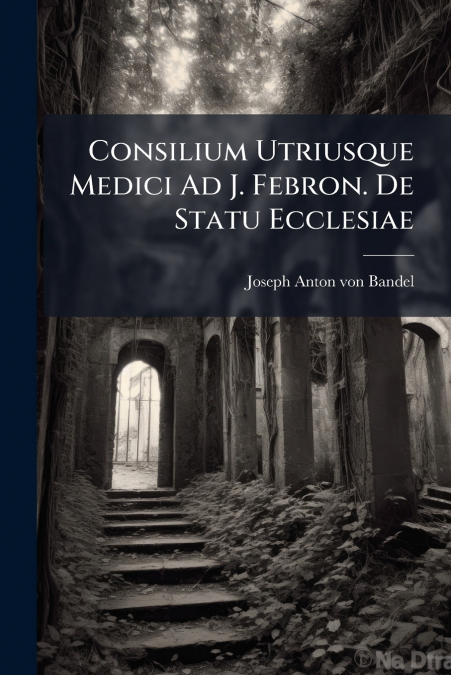
Consilium Utriusque Medici Ad J. Febron. De Statu Ecclesiae presents a detailed examination of the state of the Church, authored by Joseph Anton von Bandel. This work, likely intended as counsel from two physicians (medici), engages with the ecclesiastical theories put forth by J. Febronius, a pseudonym for Johann Nikolaus von Hontheim, a prominent figure advocating for reform within the Catholic Church during the 18th century. The book likely delves into the complexities and controversies surrounding Febronius’s views on papal authority, the role of bishops, and the structure of Church governance. Bandel’s analysis provides valuable insights into the theological and political debates that shaped the religious landscape of the time. It offers historical context on efforts to address perceived issues within the Church. This work is of interest to scholars of religious history, particularly those studying the Catholic Church and its internal reform movements during the Enlightenment era.This work has been selected by scholars as being culturally important, and is part of the knowledge base of civilization as we know it. This work was reproduced from the original artifact, and remains as true to the original work as possible. Therefore, you will see the original copyright references, library stamps (as most of these works have been housed in our most important libraries around the world), and other notations in the work.This work is in the public domain in the United States of America, and possibly other nations. Within the United States, you may freely copy and distribute this work, as no entity (individual or corporate) has a copyright on the body of the work.As a reproduction of a historical artifact, this work may contain missing or blurred pages, poor pictures, errant marks, etc. Scholars believe, and we concur, that this work is important enough to be preserved, reproduced, and made generally available to the public. We appreciate your support of the preservation process, and thank you for being an important part of keeping this knowledge alive and relevant.



![Schutzschrift Benedicti 14 [des Vierzehnten] Und Dessen Pabstl. Excommunications-bulle Gegen Die Freymaurer]( https://distri.podiprint.com/imagenes/978/1/2/7/9/8/3/4/9781279834503_f_675x675.jpg "Schutzschrift Benedicti 14 [des Vierzehnten] Und Dessen Pabstl. Excommunications-bulle Gegen Die Freymaurer")