Considered Judgment

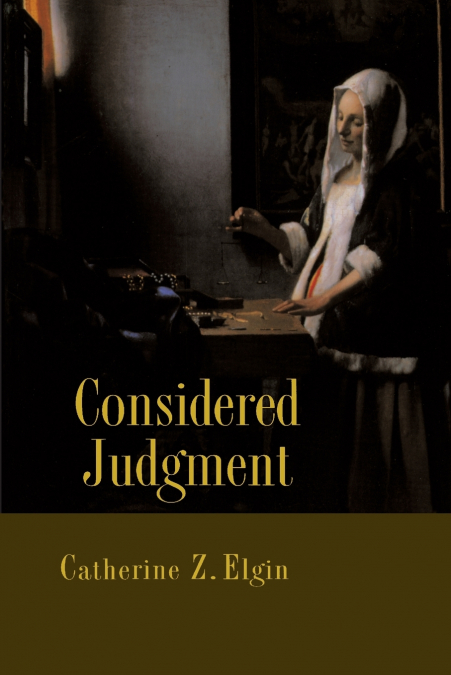
Considered Judgment

Catherine Z. Elgin / Catherine ZElgin

82,09 €
IVA incluido
Disponible
Editorial:
Princeton University Press
Año de edición:
1999
Materia
Filosofía: epistemología y teoría del conocimiento
ISBN:
9780691005232
82,09 €
IVA incluido
Disponible

Selecciona una librería:

  • Librería Samer Atenea
  • Librería Aciertas (Toledo)
  • Kálamo Books
  • Librería Perelló (Valencia)
  • Librería Elías (Asturias)
  • Donde los libros
  • Librería Kolima (Madrid)
  • Librería Proteo (Málaga)

Philosophy long sought to set knowledge on a firm foundation, through derivation of indubitable truths by infallible rules. For want of such truths and rules, the enterprise foundered. Nevertheless, foundationalism’s heirs continue their forbears’ quest, seeking security against epistemic misfortune, while their detractors typically espouse unbridled coherentism or facile relativism. Maintaining that neither stance is tenable, Catherine Elgin devises a via media between the absolute and the arbitrary, reconceiving the nature, goals, and methods of epistemology. In Considered Judgment, she argues for a reconception that takes reflective equilibrium as the standard of rational acceptability. A system of thought is in reflective equilibrium when its components are reasonable in light of one another, and the account they comprise is reasonable in light of our antecedent convictions about the subject it concerns. Many epistemologists now concede that certainty is a chimerical goal. But they continue to accept the traditional conception of epistemology’s problematic. Elgin suggests that in abandoning the quest for certainty we gain opportunities for a broader epistemological purview--one that comprehends the arts and does justice to the sciences. She contends that metaphor, fiction, emotion, and exemplification often advance understanding in science as well as in art. The range of epistemology is broader and more variegated than is usually recognized. Tenable systems of thought are neither absolute nor arbitrary. Although they afford no guarantees, they are good in the way of belief.
Artículos relacionados

  • Vier Quellen Der Erkenntnis
    Ellis Potter
    Woher wissen wir etwas? Weil es ‚wissenschaftlich bewiesen‘ ist oder ‚in der Bibel steht‘ oder es ‚sich in mir einfach richtig und wahr anfühlt ‘? Wissen wir alles auf gleiche Weise? Passen unterschiedliche Wege der Erkenntnis zusammen in ein Leben und eine Wirklichkeit?In dieser kompakten Ausgabe, dem zweiten Teil einer Trilogie, zeigt der internationale Referent Ellis Potter ...
    Disponible

    12,44 €

  • Fichte’s 1804 Wissenschaftslehre
    Illuminating new essays on Fichte’s 1804 Wissenschaftslehre, or The Science of Knowing.Fichte’s 1804 Wissenschaftslehre, or The Science of Knowing, consists of a series of lectures he delivered in his Berlin home to members of the city’s political and cultural elite in 1804. The lectures mark a dramatic shift in the terminology and methodology he uses to explore the nature of k...
  • Cybernetics for the 21st Century Vol. 1
    Andrew Pickering / Katherine Hayles
    Cybernetics for the 21st Century Vol.1 is dedicated to the epistemological reconstruction of cybernetics, consisting of a series of historical and critical reflections on the subject - which according to Martin Heidegger marked the completion of Western metaphysics. In this anthology, historians, philosophers, sociologists and media studies scholars explore the history of cyber...
    Disponible

    20,84 €

  • Huellas de San Agustín en Kant
    Javier Narváez Arango
    El libro se desarrolla en tres partes. En la primera encontramos el tiempo, el espacio, el fenómeno, el númeno, las categorías, los juicios sintéticos a priori, el mundo, el alma y Dios, expuestos por Kant en la Crítica de la razón pura. En la segunda parte encontramos los mismos temas desde san Agustín, haciendo un paralelo, para mostrar las semejanzas entre estos autores, enc...
    Disponible

    9,31 €

  • Materialist Phenomenology
    Manuel DeLanda
    Bringing together phenomenology and materialism, two perspectives seemingly at odds with each other, leading international theorist, Manuel DeLanda, has created an entirely new theory of visual perception. Engaging the scientific (biology, ecological psychology, neuroscience and robotics), the philosophical (idea of ’the embodied mind’) and the mathematical (dynamic systems the...
  • A Certain Ambiguity
    Gaurav Suri / Hartosh Singh Bal
    While taking a class on infinity at Stanford in the late 1980s, Ravi Kapoor discovers that he is confronting the same mathematical and philosophical dilemmas that his mathematician grandfather had faced many decades earlier--and that had landed him in jail. Charged under an obscure blasphemy law in a small New Jersey town in 1919, Vijay Sahni is challenged by a skeptical judge ...
    Disponible

    23,49 €