Inicio > Lenguas > Lingüistica > Conjunction, Contiguity, Contingency
Conjunction, Contiguity, Contingency

Conjunction, Contiguity, Contingency

Leo Depuydt

258,76 €
IVA incluido
Consulta disponibilidad
Editorial:
Oxford University Press
Año de edición:
1997
Materia
Lingüistica
ISBN:
9780195080926

Selecciona una librería:

  • Librería Samer Atenea
  • Librería Aciertas (Toledo)
  • Kálamo Books
  • Librería Perelló (Valencia)
  • Librería Elías (Asturias)
  • Donde los libros
  • Librería Kolima (Madrid)
  • Librería Proteo (Málaga)

Language is in large part about the description of events occurring in the world around us. Relationships of different sorts between those events can be expressed by specific verb forms - or by syntactic constructions involving specific verb forms. The present study examines this facet of the Egyptian and Coptic verbal systems in isolation, singling out three types of relationships between events and the linguistic means by which they are expressed. This book comprises three chapters on the grammar of hieroglyphic Egyptian and its linear descendant, Coptic, covering more than 3000 years of language history. The initial chapter studies the verb form called 'conjunctive', asserting that the function of the conjunctive is to 'con-join' a chain of two or more events into a single - though compound - notion. The second chapter shows how a certain syntactic construction can be used to refer to events that are contiguous - that is, events that succeed one another rapidly in time. The final chapter examines verb forms that refer to events whose occurrence is contingent on the occurrence of other events implied or explicitly mentioned in the context. The three grammatical phenomena are respectively labeled conjunction, contiguity, and contingency. The first work in which the expression of relationships between events is studied in isolation as an important characteristic of the Egyptian and Coptic verbal systems, this study constitutes a significant advancement in our understanding of the ancient language of Egypt. It will be of interest to scholars in the fields of Egyptology, Coptology, and the Ancient Near East, as well as linguists, Byzantinists, and classicists.
Artículos relacionados

  • User-Centered Computer Aided Language Learning
    Giorgos Zacharia / Panayiotis Zaphiris
    ...
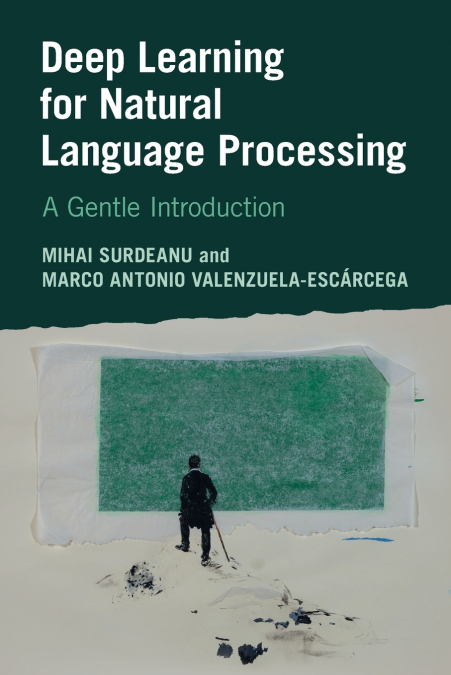
  • Deep Learning for Natural Language Processing
    Marco Antonio Valenzuela-Escárcega / Mihai Surdeanu
    ...
    Disponible

    47,60 €

  • Deep Learning for Natural Language Processing
    Marco Antonio Valenzuela-Escárcega / Mihai Surdeanu
    ...
  • Lecciones sobre espinosa medrano
    Luis Jaime Cisneros Vizquerra
    La obra de Juan de Espinosa Medrano, apodado en su tiempo «El Lunarejo» (c. 1629-1688), fue uno de los mayores focos de interés académico de Luis Jaime Cisneros (1921-2011). En 1980 aparecieron sus primeros trabajos dedicados a estudiar los textos capitales de Espinosa Medrano (el Apologético en favor de don Luis de Góngora, la Panegírica declamación por la protección de las ci...
    Disponible

    17,63 €

  • Lyre Book
    Matthew Kilbane
    Redefines modern lyric poetry at the intersection of literary and media studies.In The Lyre Book, Matthew Kilbane urges literary scholars to consider lyric not as a genre or a reading practice but as a media condition: the generative tension between writing and sound. In addition to clarifying issues central to the study of modern poetry--including its proximity to popular song...
    Disponible

    50,84 €

  • Translation-mediated Communication in a Digital World
    David Ashworth / Minako O’Hagan
    The Internet is accelerating globalization by exposing organizations and individuals to global audiences. This in turn is driving teletranslation and teleinterpretation, new types of multilingual support, which are functional in digital communications environments. The book describes teletranslation and teleinterpretation by exploring a number of key emerging contexts for langu...
    Disponible

    45,19 €

Otros libros del autor

  • From Xerxes’ Murder (465) to Arridaios’ Execution (317)
    Leo Depuydt
    This investigation consists of updates to the chronology of Achaemenid Persia (539 BCE-304 BCE). The state of Achaemenid chronology was the subject of a series of studies published by this writer about ten to fifteen years ago. Newly emerged evidence has necessitated the present updates. Errata in those earlier studies are listed in an appendix. The focus of the present investi...
    Disponible

    55,45 €

  • The Other Mathematics
    Leo Depuydt
    ...