Inicio > Tecnología, ingeniería, agricultura > > Tecnología aeroespacial y aeronáutica > Concepts of Operations for a Reusable Launch Vehicle
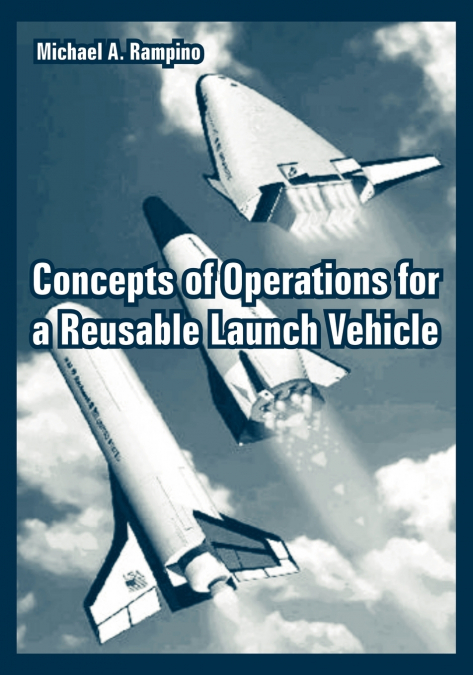
Concepts of Operations for a Reusable Launch Vehicle

Concepts of Operations for a Reusable Launch Vehicle

Michael A. Rampino / Michael ARampino

12,99 €
IVA incluido
Disponible
Editorial:
Press Holdings International
Año de edición:
2005
Materia
Tecnología aeroespacial y aeronáutica
ISBN:
9781410222411
12,99 €
IVA incluido
Disponible

Selecciona una librería:

  • Librería Samer Atenea
  • Librería Aciertas (Toledo)
  • Kálamo Books
  • Librería Perelló (Valencia)
  • Librería Elías (Asturias)
  • Donde los libros
  • Librería Kolima (Madrid)
  • Librería Proteo (Málaga)

The United States is embarked on a journey toward maturity as a spacefaring nation. One key step along the way is development of a reusable launch vehicle(RLV). The most recent National Space Transportation Policy (August 1994)assigned improvement and evolution of current expendable launch vehicles to the Department of Defense while National Aeronautical Space Administration (NASA) is responsible for working with industry on demonstrating RLV technology. The purpose of this study is to help ensure the US military, especially the USAF, is prepared to take advantage of RLVs should the NASA-led effort to develop an RLV demonstrator prove successful. The focus of this study is an explanation of how the US military could use RLVs, by describing and analyzing two concepts of operations.Four major conclusions resulted from the analysis. First, RLVs have military potential. They can perform a variety of missions including responsive spacelift, reconnaissance, and strike. However, the economic feasibility of using RLVs for earth-to-earth transportation is questionable. Second, design choices for an operational RLV will have effects on risk, cost, capability, and operations efficiency. Trade-offs will have to be made between NASA, commercial, and military requirements if all three parties are to use the same fleet of RLVs. Third, increased investment in propulsion technology development is warranted to ensure success. Fourth, the top priority for the RLV program, even from the military’s perspective, should remain cheap and responsive access to space.The research led to three recommendations. First, the US military should become a more active participant in the RLV program to ensure its requirements are defined and incorporated. Second, America should not pursue development of operational RLVs before the technology is ready. Third, it is not too early for the US military to think deeply about the implications of operational RLVs for war-fighting strategy force structure planning, training, and doctrine.

Artículos relacionados

  • Leverage Dual Space Access Architecture - Advanced Rockets and Space Elevators
    Cathy Swan
    This study assumes Space Elevators can and must be built. 'Space Elevators: The Green Road to Space,' completed in April 2021, emphasizes that Space Elevators will not replace rockets but would join them on parallel paths towards the stars. This Dual Space Access Strategy will carry out the missions that are now planned and ensure the future we dream of becomes a reality. Spac...
    Disponible

    20,30 €

  • Robust Linear Controller Design for Attitude Control of a Rocket
    Sumathi R
    Attitude control of the rocket is a big challenge in real-time. To make the rocket stable against the influences, this book has examined the control technology such as proportional integral derivative control using an anti-windup mechanism and linear quadratic regulator theory based on the degree of freedom mathematical model. The transient behaviour of both controllers is not ...
    Disponible

    98,51 €

  • Small Unmanned Aircraft
    Randal W. Beard / Timothy W. McLain
    Autonomous unmanned air vehicles (UAVs) are critical to current and future military, civil, and commercial operations. Despite their importance, no previous textbook has accessibly introduced UAVs to students in the engineering, computer, and science disciplines--until now. Small Unmanned Aircraft provides a concise but comprehensive description of the key concepts and technolo...
    Disponible

    183,66 €

  • Le tour de France en aéroplane
    H. de Graffigny
    Le tour de France en aéroplane, est un livre classique et rare, qui a été considéré comme important tout au long de l’histoire de l’humanité, et pour que cet ouvrage ne soit jamais oublié, chez Alpha Editions, nous avons fait des efforts pour sa préservation en rééditant ce livre dans un format moderne pour les générations présentes et futures. . Tout ce livre a été reformaté, ...
    Disponible

    33,66 €

  • Cybersecurity Issues and Challenges in the Drone Industry
    Cybersecurity Issues and Challenges in the Drone Industry is a comprehensive exploration of the critical cybersecurity problems faced by the rapidly expanding drone industry. With the widespread adoption of drones in military, commercial, and recreational sectors, the need to address cybersecurity concerns has become increasingly urgent. In this book, cybersecurity specialists ...
    Disponible

    361,28 €

  • Cybersecurity Issues and Challenges in the Drone Industry
    Cybersecurity Issues and Challenges in the Drone Industry is a comprehensive exploration of the critical cybersecurity problems faced by the rapidly expanding drone industry. With the widespread adoption of drones in military, commercial, and recreational sectors, the need to address cybersecurity concerns has become increasingly urgent. In this book, cybersecurity specialists ...
    Disponible

    275,83 €