 Librería Samer Atenea
 Kálamo Books
 Librería Elías (Asturias)
 Librería Kolima (Madrid)
 Librería Proteo (Málaga)
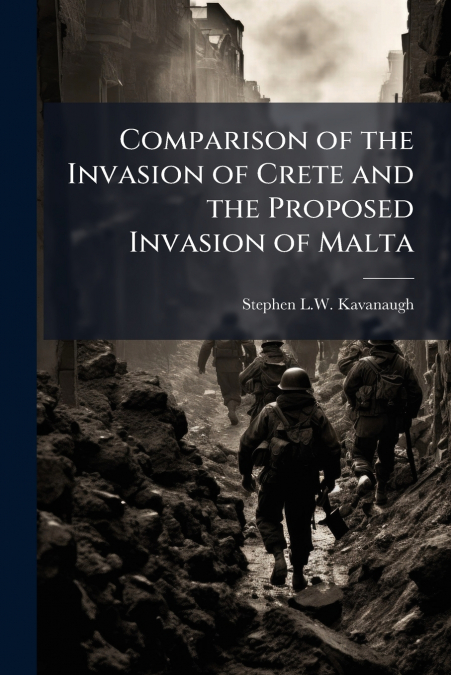
In 1941, after the conquest of Yugoslavia and Greece, senior German military leaders were considering two airborne operations, one for the invasion of Crete and the other for the invasion of Malta. The invasion of Crete was executed from 20 May to 1 June 1941 with heavy German losses. The invasion of Malta never took place even though the senior military leaders in the Oberkommando der Wehrmacht (OKW) recommended invading Malta over Crete because of its strategic importance, but were overridden by Adolf Hitler. A year later, while the North Africa campaign was being conducted, another invasion was planned for Malta, but within a few weeks of executing the plan it too was postponed and eventually cancelled. The primary focus of this research is to establish why in 1941 Crete was invaded, but Malta was not. The secondary focus is to establish why one year later a second planned invasion of Malta was rejected and abandoned, and what were the strategic repercussions of not invading Malta. The Axis never captured Malta, and the offensive capability of Malta was never destroyed, thus leading to the defeat of all Axis forces in North Africa.This work has been selected by scholars as being culturally important, and is part of the knowledge base of civilization as we know it. This work was reproduced from the original artifact, and remains as true to the original work as possible. Therefore, you will see the original copyright references, library stamps (as most of these works have been housed in our most important libraries around the world), and other notations in the work.This work is in the public domain in the United States of America, and possibly other nations. Within the United States, you may freely copy and distribute this work, as no entity (individual or corporate) has a copyright on the body of the work.As a reproduction of a historical artifact, this work may contain missing or blurred pages, poor pictures, errant marks, etc. Scholars believe, and we concur, that this work is important enough to be preserved, reproduced, and made generally available to the public. We appreciate your support of the preservation process, and thank you for being an important part of keeping this knowledge alive and relevant.