Inicio > Sociedad y ciencias sociales > Psicología > Comment et pourquoi recherchons-nous le pardon ?
Comment et pourquoi recherchons-nous le pardon ?

Comment et pourquoi recherchons-nous le pardon ?

Jessica Rourke / Kathryn Belicki

63,58 €
IVA incluido
Disponible
Editorial:
KS OmniScriptum Publishing
Año de edición:
2025
Materia
Psicología
ISBN:
9786209052361
63,58 €
IVA incluido
Disponible

Selecciona una librería:

  • Librería Samer Atenea
  • Librería Aciertas (Toledo)
  • Kálamo Books
  • Librería Perelló (Valencia)
  • Librería Elías (Asturias)
  • Donde los libros
  • Librería Kolima (Madrid)
  • Librería Proteo (Málaga)

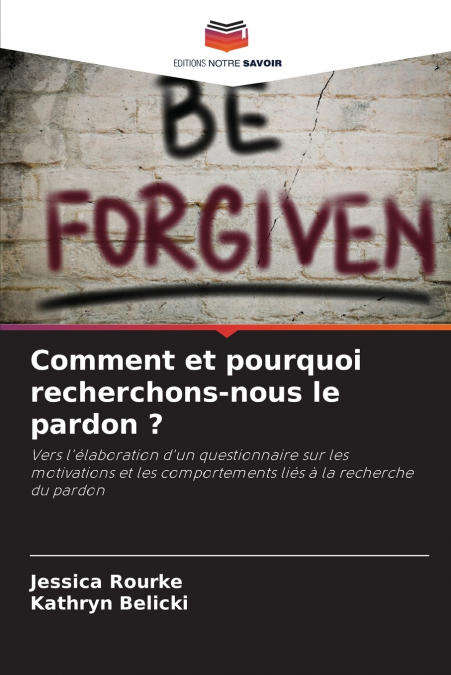
Après avoir commis une infraction dans le cadre d’une relation, un délinquant peut être motivé à réduire les dommages. Nous avons examiné les motifs qui peuvent pousser un délinquant à demander pardon, tels que le refus d’être puni, le souci de son image publique, son bien-être émotionnel, l’image qu’il a de lui-même, son sens de l’équité/de la justice, la perte d’une relation, la perte ou le gain de pouvoir et la perte de la capacité à faire confiance. Nous avons également examiné les comportements qu’un délinquant pourrait adopter après avoir commis une infraction. Nous avons demandé à 221 personnes de s’imaginer dans la peau d’un délinquant dans des scénarios hypothétiques et de répondre à des questions sur la manière dont elles agiraient dans une telle situation. Nous avons identifié six principaux domaines qui motivent les individus à agir : le souci de Dieu, le souci de l’estime de soi, le souci de la justice, le souci de l’image, le souci des parties concernées et des autres, et le souci des relations. En outre, nous avons constaté qu’après avoir commis une infraction, les individus adoptent généralement quatre types de comportements : l’approche, l’évitement, le déni et la dissimulation, et la soumission. Dans cet ouvrage, nous nous lançons dans une discussion approfondie de tous ces motifs et comportements et explorons leur lien avec la gravité de l’infraction et la personnalité du délinquant.


Artículos relacionados

  • Drinkers of Infinity
    Arthur Koestler
    This selection of essays, book-reviews, broadcast talks and papers delivered to learned societies reflects the extraordinary breadth of Arthur Koestler’s interests. From the trial of Galileo to the pleasures of canoeing down the Loire, from a detailed examination of the ‘memory’ of flatworms to an equally detailed examination of the futility of quarantining dogs, the author wri...
    Disponible

    17,24 €

  • Gordy the Rabbit has ADHD
    Jessie Shepherd
    Often when people are given a mental health disorder diagnosis the weaknesses are clear and overwhelmingly emphasized, while the strengths are ignored or forgotten. The mental health children's book series 'What Mental Disorder?' challenges the stigma against therapy and diagnosis. It enlists the reader to view the character as a whole being and not as a mental issu...
    Disponible

    16,30 €

  • The Paradoxical Ego
    Eugene Halliday / Zhu Kabere
    Three particular themes are basic to this study. First, that the human race and its environment are involved in a slowly progressive process of revelation and understanding of its inherent features; and that we are all participating in this ongoing evolutionary cycle. Second, and closely related to the first tenet, man is not separable from his environment. We all share in this...
    Disponible

    14,56 €

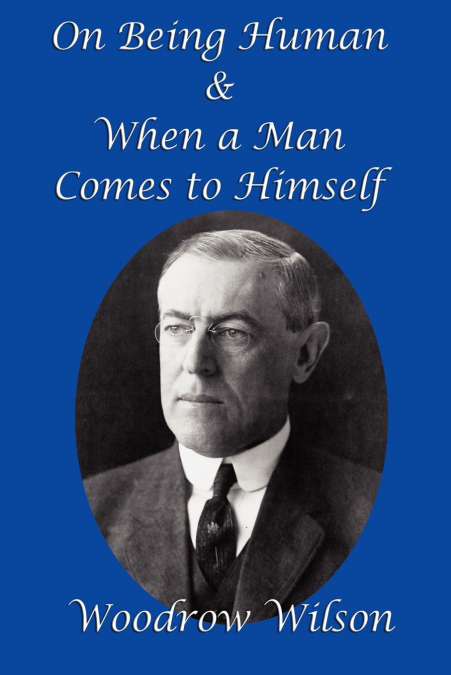
  • On Being Human and When a Man Comes to Himself
    Woodrow Wilson
    Before he became the 28th President of the United States (1913-21), the 34th Governor of New Jersey (1911-13), or even the 13th President of Princeton University (1902-10), Woodrow Wilson (1856-1924) was a scholar and professor. In 1885, he received his Ph.D. in history and political science from Johns Hopkins University, and in 1897, he was granted tenure at Princeton Universi...
    Disponible

    6,28 €

  • Bridge Over The River Why
    David Cooper / Deborah Cooper
    'In Bridge Over the River Why, the Coopers have succeeded in a dual task documenting their own journey through the grief of losing their son Eli by suicide, while at the same time providing a valuable resource for anyone who has had to face the same terrible tragedy. They start with the premise that 'doing and feeling' are the key components of moving forward and have a core me...
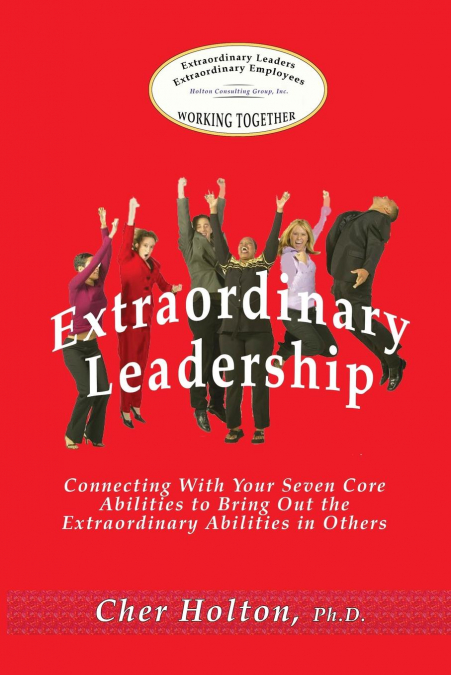
  • Extraordinary Leadership
    Cher Holton
    This transformational leadership book, grounded in state-of-the-art research and proven by real-life application in the trenches, moves beyond traditional leadership theories to introduce you to seven incredible Core Abilities and shows you how to connect with them to become an Extraordinary Leader who can bring out the very best in your people.All the techniques in the world w...
    Disponible

    23,85 €

Otros libros del autor

  • Jak i dlaczego prosimy o przebaczenie?
    Jessica Rourke / Kathryn Belicki
    Po popełnieniu przestępstwa w kontekście relacji międzyludzkich sprawca może być zmotywowany do zmniejszenia szkód. Zbadaliśmy motywy, które mogą skłaniać sprawcę do szukania przebaczenia, takie jak uniknięcie kary, troska o wizerunek publiczny, dobre samopoczucie emocjonalne, samoocena, poczucie sprawiedliwości, utrata relacji, utrata lub zdobycie władzy oraz utrata zdolności ...
    Disponible

    63,58 €

  • Wie und warum bitten wir um Vergebung?
    Jessica Rourke / Kathryn Belicki
    Nach einer Straftat im Rahmen einer Beziehung kann ein Täter motiviert sein, den Schaden zu mindern. Wir haben die Motive untersucht, die ein Täter haben kann, um Vergebung zu suchen, wie z. B. Vermeidung von Strafe, Sorge um das öffentliche Ansehen, emotionales Wohlbefinden, Selbstbild, Sinn für Fairness/Gerechtigkeit, Verlust der Beziehung, Verlust oder Gewinn von Macht und V...
    Disponible

    63,58 €

  • Come e perché cerchiamo il perdono?
    Jessica Rourke / Kathryn Belicki
    A seguito di un reato commesso nel contesto di una relazione, il colpevole può essere motivato a ridurre il danno. Abbiamo esaminato le motivazioni che possono spingere un colpevole a cercare il perdono, quali l’evitare la punizione, le preoccupazioni relative all’immagine pubblica, il benessere emotivo, l’immagine di sé, il senso di equità/giustizia, la perdita della relazione...
    Disponible

    63,50 €

  • Como e por que buscamos o perdão?
    Jessica Rourke / Kathryn Belicki
    Após cometer uma ofensa no contexto de um relacionamento, o ofensor pode sentir-se motivado a reduzir os danos. Examinámos os motivos que um ofensor pode ter para buscar o perdão, tais como evitar punições, preocupações com a imagem pública, bem-estar emocional, autoimagem, senso de justiça, perda de relacionamentos, perda ou ganho de poder e perda da capacidade de confiar. Tam...
    Disponible

    63,50 €