

 Librería Samer Atenea
 Kálamo Books
 Librería Elías (Asturias)
 Librería Kolima (Madrid)
 Librería Proteo (Málaga)
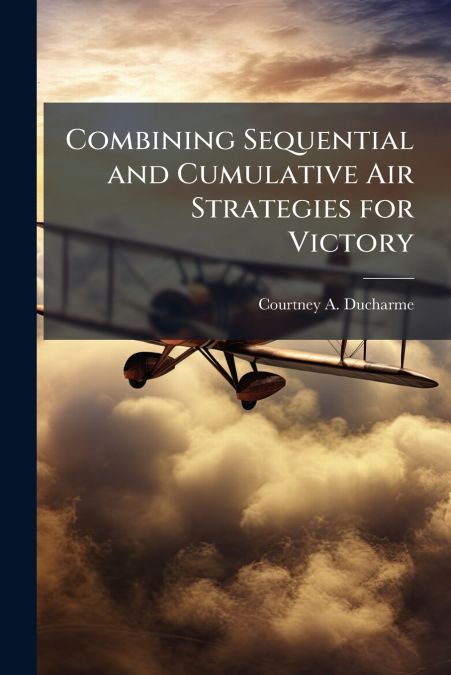
This study analyzes how sequential and cumulative aspects of air strategies interact to contribute to victory in war. The thesis uses as a point of departure the 1967 writing of Admiral J.C. Wylie, Military Strategy: A General Theory of Power Control. In this book Wylie describes two basic military strategies, sequential and cumulative. The sequential strategy consists of a 'series of visible, discrete steps, each dependent on the one that preceded it.' A cumulative strategy is 'the less perceptive minute accumulation of little items piling one on top of the other until at some unknown point the mass of accumulated actions may be large enough to be critical.' This study provides a preliminary analysis about the interaction of such aspects of air strategy by examining three historical campaigns: the Battle of Britain (from the German perspective), the Combined Bomber Offensive, and the Southwest Pacific Area campaign.This work has been selected by scholars as being culturally important, and is part of the knowledge base of civilization as we know it. This work was reproduced from the original artifact, and remains as true to the original work as possible. Therefore, you will see the original copyright references, library stamps (as most of these works have been housed in our most important libraries around the world), and other notations in the work.This work is in the public domain in the United States of America, and possibly other nations. Within the United States, you may freely copy and distribute this work, as no entity (individual or corporate) has a copyright on the body of the work.As a reproduction of a historical artifact, this work may contain missing or blurred pages, poor pictures, errant marks, etc. Scholars believe, and we concur, that this work is important enough to be preserved, reproduced, and made generally available to the public. We appreciate your support of the preservation process, and thank you for being an important part of keeping this knowledge alive and relevant.





