

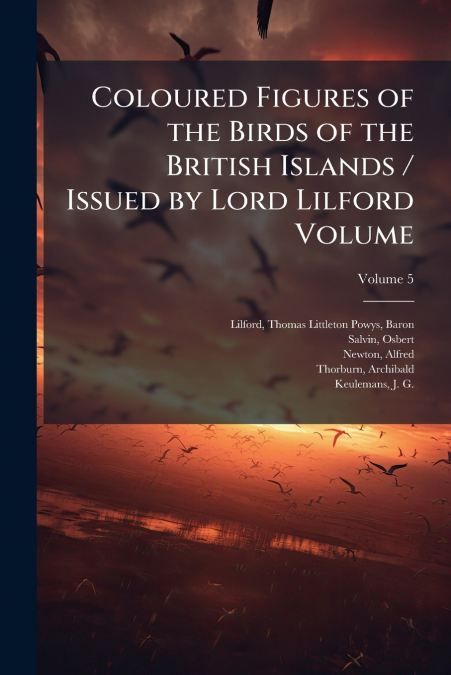
Newton Alfred 1829-1907 / Salvin Osbert 1835-1898 / Thomas Littleton Powys Baron Lilford
 Librería Samer Atenea
 Kálamo Books
 Librería Elías (Asturias)
 Librería Kolima (Madrid)
 Librería Proteo (Málaga)
Delve into the avian wonders of the British Isles with 'Coloured Figures of the Birds of the British Islands,' Volume 5, issued by Lord Lilford. This exquisite volume, a collaborative effort of renowned naturalists and artists including Lord Lilford, Osbert Salvin, Alfred Newton, Archibald Thorburn, and J. G. Keulemans, presents detailed and beautifully rendered illustrations of British birds. Originally published in 1885, this work offers invaluable insights into the bird species inhabiting the region during that era. Ornithologists, historians, and birdwatching enthusiasts will appreciate the meticulous detail and artistry captured in each plate, making this a timeless contribution to the field of natural history. Discover the rich diversity of British birdlife through the eyes of some of the foremost experts of the 19th century.This work has been selected by scholars as being culturally important, and is part of the knowledge base of civilization as we know it. This work was reproduced from the original artifact, and remains as true to the original work as possible. Therefore, you will see the original copyright references, library stamps (as most of these works have been housed in our most important libraries around the world), and other notations in the work.This work is in the public domain in the United States of America, and possibly other nations. Within the United States, you may freely copy and distribute this work, as no entity (individual or corporate) has a copyright on the body of the work.As a reproduction of a historical artifact, this work may contain missing or blurred pages, poor pictures, errant marks, etc. Scholars believe, and we concur, that this work is important enough to be preserved, reproduced, and made generally available to the public. We appreciate your support of the preservation process, and thank you for being an important part of keeping this knowledge alive and relevant.





