

de Boisgrollier / de Lizárraga
 Librería Samer Atenea
 Kálamo Books
 Librería Elías (Asturias)
 Librería Kolima (Madrid)
 Librería Proteo (Málaga)
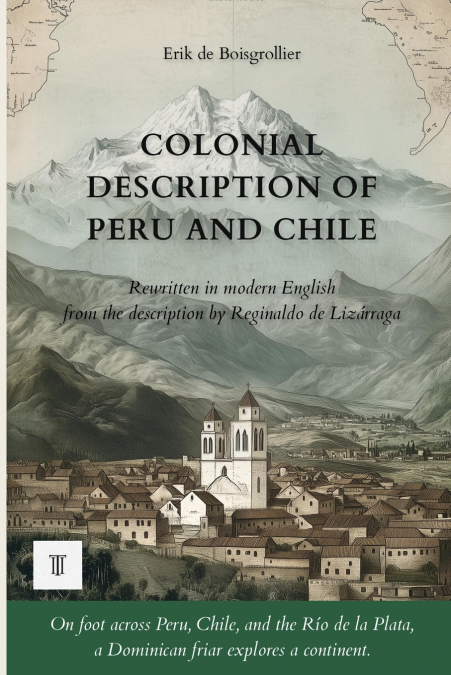
Around 1605, in a convent in Paraguay, Reginaldo de Lizárraga completes a manuscript begun fifteen years earlier. Arriving in Peru at the age of fifteen with his parents, this Spaniard took the Dominican habit and, for half a century, traveled the immense lands stretching from Quito to the Strait of Magellan. Prior, provincial, and finally bishop, he watched Lima in the days of its unfinished cathedral, Potosí at the height of its mining wealth, and Cuzco in the years after the execution of the last Inca. He crossed the northern valleys of Peru and the sands where the huacas of Trujillo lie, climbed into the heart of the Andes, and lingered on the shores of Lake Titicaca before entering the troubled province of Charcas, where the Chiriguano held the frontier. He saw Francis Drake slip into the roadstead of Callao one night, the fury of the Chiriguano overwhelm Viceroy Toledo’s expedition against the last Inca of Vilcabamba, and the unconquered Mapuche of Chile kill Governor Martín García de Loyola at Curalaba.His book is a living inventory of the Spanish New World: cities, valleys, mines, convents, viceroys, Indians, pirates, and martyrs, described by a witness who traveled it all on muleback and judged none of it gently. He portrays the viceroys in arms, from the marquis of Cañete to Toledo the reformer, follows the corsair’s shadow along the Pacific coast in the years after Drake’s raid, and reaches, beyond Tucumán and the waters of Paraguay, the islands at the end of the world and the unsubdued frontiers of Chile. Left unpublished for three centuries, the manuscript was not printed until 1909, in Buenos Aires. This English edition restores it in the full density of its documentary and literary substance, faithful to the voice of a man who made the New World his home for sixty years and who spared no one his judgment, neither colonist nor Indian, neither pirate nor fellow friar.The whole is illustrated with fifteen original engravings, accompanied by six maps of sixteenth-century colonial America, a glossary of colonial terms, a chronology of the author and his era, an index of persons and an index of places, as well as selected passages from the original Spanish text.





