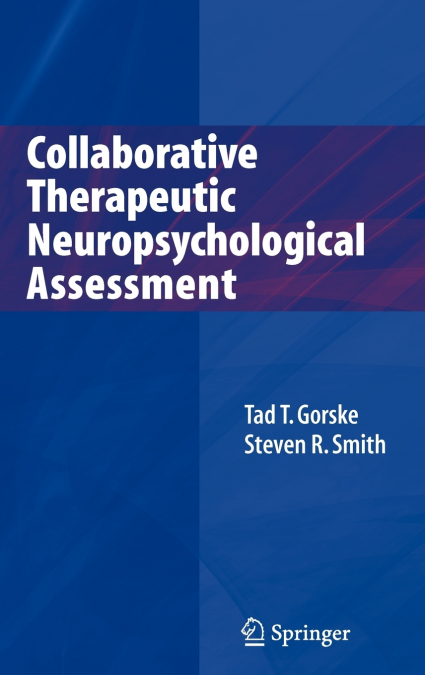
Steven R. Smith / Tad T. Gorske
 Librería Samer Atenea
 Kálamo Books
 Librería Elías (Asturias)
 Librería Kolima (Madrid)
 Librería Proteo (Málaga)
Foreword by Stephen Finn, Center for Therapeutic Assessment I. Introduction: Overview and Background of CTNA a. This chapter will begin with brief case examples of feedback sessions conducted in a traditional manner and according to CTNA methods as a segue to an overview of CTNA as contrasted with standard practice in neuropsychological assessment, commonly referred to as the ’information gathering model.’ b. The next section describes current challenges facing the field of Clinical Neuropsychology. Psychological and neuropsychological assessment have struggled in the era of managed care for a number of reasons, not the least of which include the advent of radiology methods for identifying brain lesions, consumer and provider misunderstanding of the rationale and usefulness of neuropsychological assessment, and the identity confusion many neuropsychologists face in the roles of treatment and rehabilitation planning. CTNA will be introduced as a method for meeting these challenges and helping to make neuropsychological assessment responsive to consumers, providers, and referral sources while enhancing collaboration between professions. An overview will be provided of a published survey, conducted by the editors, on neuropsychological assessment feedback practices. II. Conceptual Foundations: Brief history of neuropsychological assessment feedback a. Therapeutic Assessment Models: The historical background for using psychological testing as a collaborative and therapeutic intervention. First, a review of the early projective test studies will be described. Then the chapter will describe Constance Fischer’s Individualized Psychological Assessment and Stephen Finn’s Therapeutic Psychological Assessment. b. Luria’s work: The chapter will begin with an analysis of Alexandr Rumanovich Luria’s Neuropsychological Investigation and how his methodology provides aprecursor to contemporary client centered neuropsychological interventions and rehabilitation. c. Literature review: Second, a review of the empirical literature will be provided on recommendations for providing feedback from neuropsychological tests. d. Motivational Interviewing: The next generation of client centered feedback. The section will discuss the application of Motivational Interviewing methods for providing client centered feedback. This is relevant because CTNA feedback methods are based on the MI conceptual framework. e. Contemporary applications: In this section a review will be provided on the current work being conducted on CTNA methods. This will include a review of research conducted by the primary editors; the work of Dr. Diane Engelman from the Center for Collaborative Psychology and Psychiatry; Dr. John Strang’s work with the Neuropsychology School Conference; and the study by Dr. Phillip Pegg on providing medical and neuropsychological information to traumatic brain injury patients. III. CTNA Model Basic Assumptions of CTNA . The patient/caregiver/referral source have noticed a change in the patients cognitive and/or behavioral functioning and would like a professional to tell them if there is a true change and to what degree, severity, and if possible potential causes. The patient/family are distressed because of the change in the patient’s cognitive/behavioral functioning. Part of the reason they are coming in for the evaluation is to receive help, direction, and guidance in order to feel less distressed. Patients would like to know of potential ameliorative strategies so that the patient performs better in school, work, social spheres, and begins to feel better about him/herself.