
Codes and Ciphers of the Civil War

Codes and Ciphers of the Civil War

William F. Friedman

16,08 €
IVA incluido
Disponible
Editorial:
W. Frederick Zimmerman
Año de edición:
2024
ISBN:
9781608883035
16,08 €
IVA incluido
Disponible

Selecciona una librería:

  • Librería Samer Atenea
  • Librería Aciertas (Toledo)
  • Kálamo Books
  • Librería Perelló (Valencia)
  • Librería Elías (Asturias)
  • Donde los libros
  • Librería Kolima (Madrid)
  • Librería Proteo (Málaga)

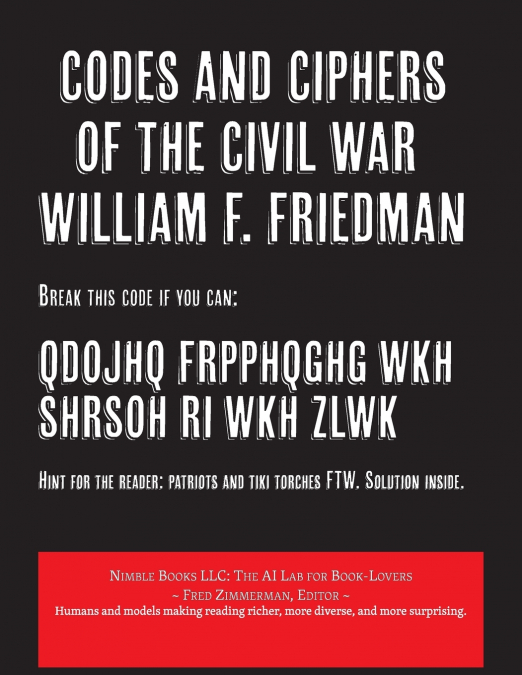
Break this code:QDOJHQ FRPPHQGHG WKH SHRSOH RI WKH ZLWKHint for the reader: patriots and tiki torches FTW. Solution inside.This famous lecture by William F. Friedman, the father of American cryptography, provides a fascinating glimpse into the world of cryptology during the American Civil War, examining the systems used by both Union and Confederate forces.Key Points:Albert J. Myer and the Signal Corps: The lecture details Myer’s development of the 'wig-wag' system of visual signaling and the subsequent establishment of the Signal Corps. The initial lack of electrical telegraphy capabilities and the ensuing rivalry with the U.S. Military Telegraph Corps (USMTC) created significant challenges for the Signal Corps.Union Cryptosystems: The lecture describes the two primary cryptosystems used by the Union:Myer’s Cipher Disk: Employed by the Signal Corps for tactical communications, this disk allowed for changing the visual signal equivalents for letters, offering a basic level of encryption.Route Ciphers: Utilized by the USMTC for strategic communications, these ciphers involved transposing words within a matrix, offering a more complex level of encryption compared to the Myer disk.Confederate Cryptosystems: The lecture explains the Confederate reliance on the Vigenère cipher, also known as the 'court cipher,' for both tactical and strategic communications. This system used a keyword to shift alphabets cyclically, providing a polyalphabetic encryption method.Weaknesses of the Systems: The lecture critically examines the weaknesses of both Union and Confederate cryptosystems:Myer’s Cipher Disk: Susceptible to cryptanalysis due to its monoalphabetic nature.Route Ciphers: Vulnerable if codebooks were captured, and the limited number of code words reduced their effectiveness.Confederate Vigenère Ciphers: Leaving words unenciphered and revealing word lengths through the cipher text compromised security. Additionally, the limited number of keys used during the war made them susceptible to cryptanalysis.Additional Observations:The lecture highlights the importance of cryptology in warfare, emphasizing its role in secure communication and the impact of insecure communications on the outcome of battles and campaigns.It reveals the lack of advanced cryptographic knowledge during the Civil War era, with both sides relying on relatively simple systems that were often vulnerable to cryptanalysis.The lecture raises interesting questions about the effectiveness of the Union and Confederate cryptosystems and the potential impact of their weaknesses on the course of the war.Overall, the lecture provides a valuable introduction to the fascinating world of Civil War cryptology and offers insights into the evolution of secure communications in warfare.
Artículos relacionados

  • Privacy, Intrusion Detection and Response
    Peyman Kabiri
    Though network security has almost always been about encryption and decryption, the field of network security is moving towards securing the network environment rather than just stored or transferred data. Privacy, Intrusion Detection and Response: Technologies for Protecting Networks explores the latest practices and research works in the area of privacy, intrusion detection, ...
  • Current Trends in Cyber Security
    Irina du Quenoy / Neil Kent
    This groundbreaking collection of essays assesses how cyber security affects our lives, businesses, and safety. The contributors -- all leaders in their fields -- have produced approach cyber security from multiple innovative angles. Business professor Matthew Cadbury takes a long view, studying earlier intelligence failures in the field of conventional conflict to identify pat...
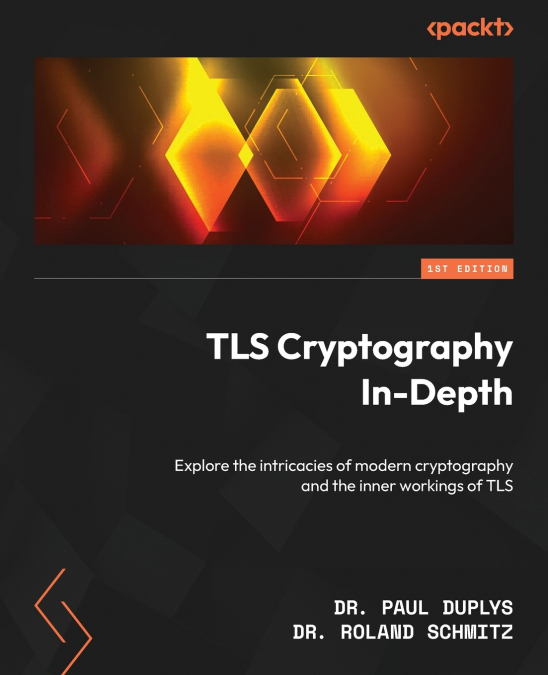
  • TLS Cryptography In-Depth
    Dr. Paul Duplys / Dr. Roland Schmitz
    A practical introduction to modern cryptography using the Transport Layer Security protocol as the primary referenceKey Features- Learn about real-world cryptographic pitfalls and how to avoid them- Understand past attacks on TLS, how these attacks worked, and how they were fixed- Discover the inner workings of modern cryptography and its application within TLS- Purchase of the...
    Disponible

    75,87 €

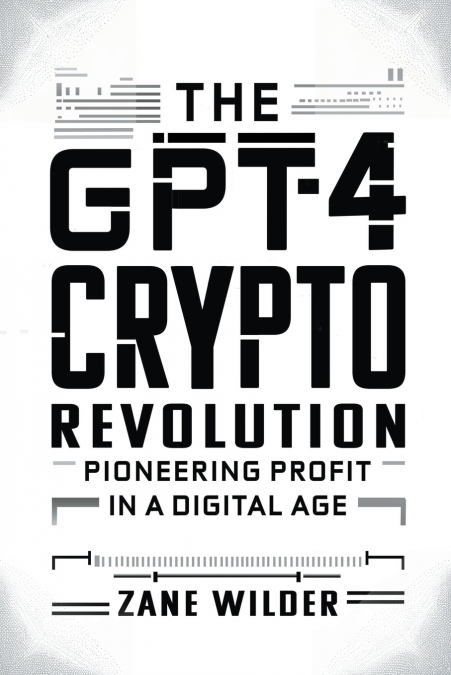
  • The GPT-4 Crypto Revolution
    Zane Wilder
    Discover the power of AI in the crypto world, from Bitcoin’s disruptive emergence to GPT-4’s cutting-edge analysis. Find out how savvy investors conquer the digital currency frontier. Learn how AI can reshape risk, outsmart markets, and secure your crypto journey. AI Insights: Unravel market trends using GPT-4’s accurate predictions.Strategy Development: Forge robust strategies...
    Disponible

    20,26 €

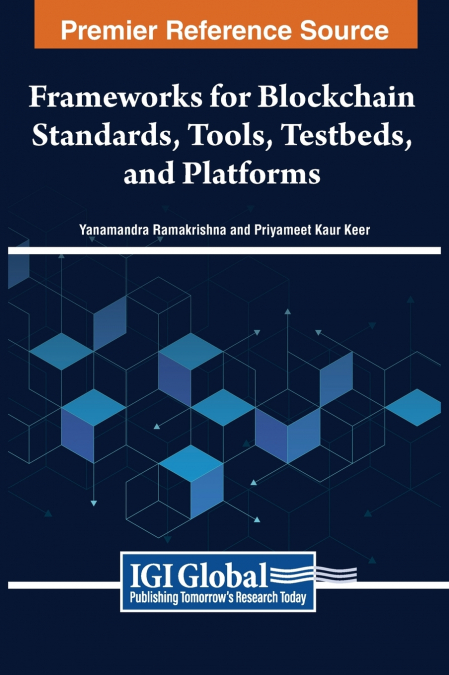
  • Frameworks for Blockchain Standards, Tools, Testbeds, and Platforms
    In an era of rapid technological advancements, blockchain technology has emerged as a groundbreaking solution for decentralized trust and immutable record-keeping. Frameworks for Blockchain Standards, Tools, Testbeds, and Platforms delves into the intricate world of blockchain, offering a comprehensive exploration of its various dimensions. At its core, blockchain disrupts the ...
  • Innovative Machine Learning Applications for Cryptography
    Data security is paramount in our modern world, and the symbiotic relationship between machine learning and cryptography has recently taken center stage. The vulnerability of traditional cryptosystems to human error and evolving cyber threats is a pressing concern. The stakes are higher than ever, and the need for innovative solutions to safeguard sensitive information is unden...
    Disponible

    294,49 €

Otros libros del autor

  • The Friedman Lectures on Cryptology
    William F. Friedman
    In a world increasingly reliant on digital communication, the need for robust security measures is paramount. This document, a collection of lectures by the dean of American cryptologists, William F. Friedman, throws open the curtains on the captivating history of cryptography, a science woven into the fabric of human communication and national security. The lectures illuminate...