 Librería Samer Atenea
 Kálamo Books
 Librería Elías (Asturias)
 Librería Kolima (Madrid)
 Librería Proteo (Málaga)
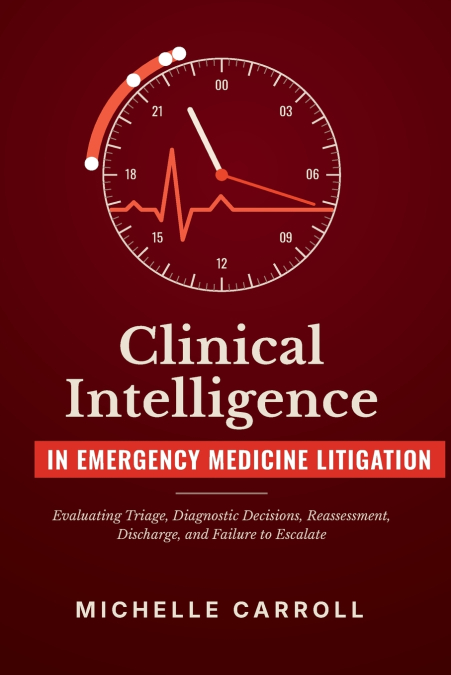
Do not let the final diagnosis erase the uncertainty that came before it.Emergency-department cases are judged backward. Once the ending is known, a crowded and uncertain encounter looks like a straight line, and every missed sign looks obvious. The real question is narrower and more demanding: whether the emergency team managed uncertainty in a way that protected the patient as the clinical story developed.Clinical Intelligence in Emergency Medicine Litigation gives attorneys a disciplined method for answering that question. Michelle Carroll, founder of Lexcura Summit and creator of the Lexcura Clinical Intelligence Model, draws on more than forty years of healthcare experience to show counsel how to reconstruct an emergency encounter as it was experienced, identify the turning point, evaluate decisions prospectively rather than through hindsight, and separate a process failure from what actually caused the harm.The book applies the seven pillars of the Lexcura Clinical Intelligence Model to the emergency record: Record Integrity, Baseline Profiling, Imaging Analysis, Timeline Reconstruction, Standard of Care Review, Regulatory and Compliance Overlay, and Causation Mapping. Together they produce a litigation-ready output that tells counsel what the record supports, what remains uncertain, and where qualified expert judgment is required.Inside, readers will find:- The legal framework of emergency medicine negligence, including apparent agency, corporate negligence, heightened emergency-care standards, comparative fault, deadlines, and pre-suit requirements- A full chapter on EMTALA: the medical screening examination, stabilization, transfer, on-call obligations, and how federal claims differ from malpractice claims- How to obtain the complete emergency record, including audit trails, tracking boards, EMS records, monitor data, preservation, and privilege- Triage, the differential diagnosis, reassessment, clinical decision tools, critical results and callbacks, handoffs, supervision of advanced practice providers and residents, boarding, discharge, patients who leave, language access, and transfer- Chest pain, stroke, sepsis, pediatric emergencies, abdominal and obstetric emergencies, trauma, older adults, behavioral health, overdose and suicide risk, and care in freestanding emergency departments, urgent care, observation, and telemedicine- Expert testimony and admissibility, loss of chance, damages and case valuation, discovery, and deposition strategy- 27 worked case examples analyzed pillar by pillar, 47 diagrams, a records request checklist, a four-clock timeline worksheet, a case screening form, deposition outlines, expert question sets, a glossary, and a table of authoritiesThe approach is balanced by design. The same analysis can support a claim, narrow it, or show that the care was reasonable despite a devastating outcome. That makes the book equally useful to plaintiff counsel screening a new matter, defense counsel reconstructing prospective reasonableness, and the clinical professionals who support them.Written for medical malpractice and personal injury attorneys, healthcare defense counsel, insurance and risk professionals, legal nurse consultants, and Clinical Intelligence analysts, this book turns a dense and chaotic emergency record into a disciplined account of risk, response, change, responsibility, and consequence.Medical attorneys do not need another summary of what the chart says. They need to know what the chart means, where the evidence is reliable, where the reasoning changed, and whether a different course probably would have changed the outcome. That is Clinical Intelligence in emergency medicine litigation.