

 Librería Samer Atenea
 Kálamo Books
 Librería Elías (Asturias)
 Librería Kolima (Madrid)
 Librería Proteo (Málaga)
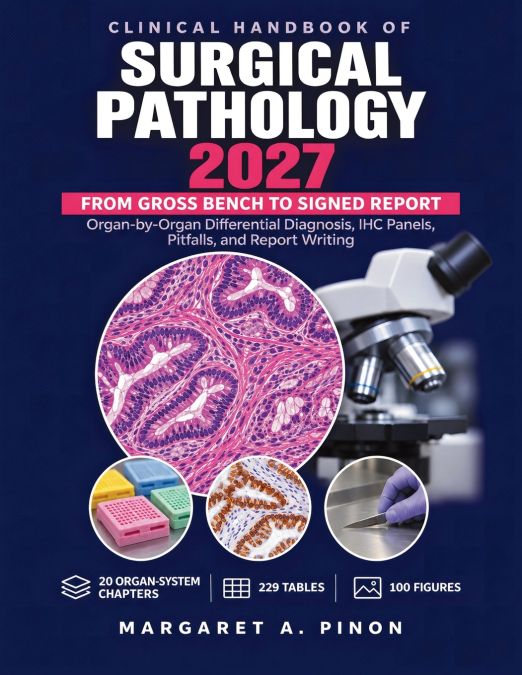
From the gross bench to the signed report, organ by organ. Surgical pathology is learned one specimen at a time, but the knowledge it needs is scattered across grossing manuals, frozen section guides, differential diagnosis atlases, immunostain references, and reporting protocols. This handbook brings that workflow into one place. It follows the specimen from requisition and accessioning through grossing, frozen section, microscopy, immunohistochemistry, and molecular testing to a clear, complete report, and then works through every major organ system in the same fixed order, so the answer to each question is always where you expect it. What each organ chapter gives you Grossing: steps, inking schemes, and block selection for the common resections and biopsies. Frozen section: decision points, with the questions the surgeon is really asking. Differential diagnosis: tables that set each entity beside its mimics. Immunohistochemistry: which stains to order, in what combination, and how to read them. Molecular markers: what is tested and why it changes the diagnosis or treatment. Pitfalls: the check that catches each one before sign-out. Reporting: required elements, margins, lymph nodes, and the wording that clinicians act on. Current to the standards in force Classification follows the WHO Classification of Tumours volumes in force in late 2026, including the sixth edition Digestive System volume, with the 2022 International Consensus Classification alongside it for lymphoid neoplasms. Staging follows the AJCC eighth edition and the Version 9 chapters released site by site. A Standards and Currency table at the front lists every edition and version used. Built to be used at the bench A large 8.5 x 11 page, full color tables, tinted panels for pitfalls, call-the-clinician findings, and report wording, and a case that opens and closes each chapter. Five appendices gather grossing summaries, an immunostain reference, grading and staging tables, quality benchmarks, and a terminology crosswalk, with a specimen finder at the front and a glossary, references, and index at the back. Written for pathology residents and fellows, practicing surgical pathologists, pathologists’ assistants, and the surgeons and oncologists who read pathology reports. This book is an educational reference. It does not replace your laboratory’s validated procedures, the current versions of the classification and staging systems, or professional judgment applied to each specimen.





