Casey Crouse / Steve 'Ardalis' Smith
 Librería Samer Atenea
 Kálamo Books
 Librería Elías (Asturias)
 Librería Kolima (Madrid)
 Librería Proteo (Málaga)
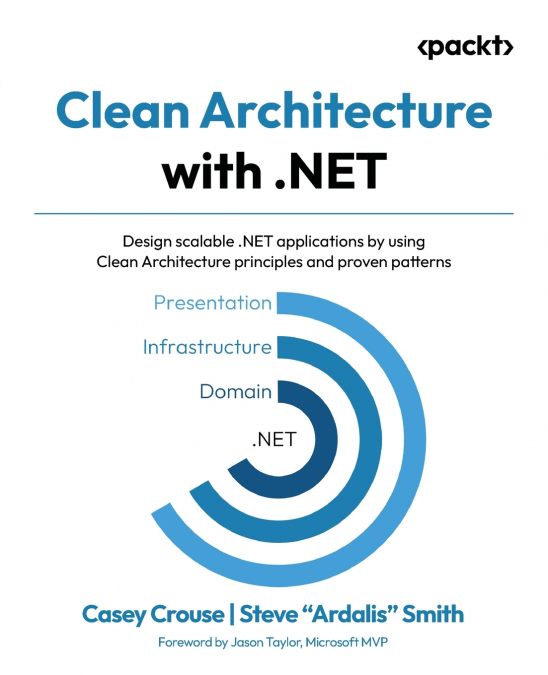
Learn Clean Architecture as a set of organizing principles, not just code templates. This book shows how to design scalable, testable .NET apps using modern patterns, DDD, CQRS, and secure Azure integration.Free with your book: DRM-free PDF version + access to Packt’s next-gen Reader* Key Features:- Architect robust .NET apps with domain-driven, testable Clean Architecture- Integrate Azure External ID and Key Vault with real-world cases- Apply MediatR, CQRS, and modern .NET practices to streamline architecture- Implement persistence with EF Core using a code-first approach and Clean Architecture boundaries- Purchase of the print or Kindle book includes a free PDF eBookBook Description:Learn how to apply Clean Architecture in real-world .NET applications with Azure in this guide. Designed around an e-commerce project - Project Odyssey, you’ll design and build every architectural layer, from core domain logic and application orchestration to infrastructure and presentation.This book equips you to apply DDD, CQRS, MediatR, and dependency injection, enabling loosely coupled, testable systems. You’ll build reusable and modular code structures that scale with your application’s complexity and learn how to persist data using EF Core with a code-first approach, managing schema evolution with migrations while keeping infrastructure concerns isolated from your domain logic. Learn how to develop secure systems by integrating Azure External ID, Azure Key Vault, and application-level authentication and authorization.Gain practical experience with Blazor Server, Razor components, and MudBlazor UI, all integrated within a layered architecture. Learn to enforce business logic boundaries, reduce boilerplate with generic request handlers, and use real-world use cases like payment processing and shopping cart management.Whether you’re new to Clean Architecture or scaling up enterprise solutions, this book provides the patterns, tools, and mindset to succeed.*Email sign-up and proof of purchase requiredWhat You Will Learn:- Design scalable .NET applications with Clean Architecture principles- Structure core logic using use cases, CQRS, and domain modeling- Integrate Azure External ID, Key Vault, and secure service configurations- Use EF Core with a code-first approach to manage database schemas and persistence- Apply MediatR and FluentValidation for streamlined workflows- Build rich UIs using Blazor Server and MudBlazor- Build scalable multi-host applications with structured, transparent service composition- Reduce architectural boilerplate while maintaining structureWho this book is for:.NET developers, software engineers, and solution architects who want to build applications that are easier to understand, test, and evolve over time. This book is a good fit if you’re already familiar with C# and .NET, and want a clearer, more practical way to structure real-world applications using Clean Architecture. Basic knowledge of web development and Azure will help you follow along.Table of Contents- Understanding the Limitations of Tightly Coupled Architectures- Introduction to Clean Architecture- Adapting Clean Architecture to .NET- Designing a Clean Architecture Application- Implementing the Core Layer- Implementing the Infrastructure Layer- Implementing the Persistence Layer- Implementing the Presentation Layer with Identity- Building Secure, Testable UI Components for Use Cases- Improving Clean Architecture in .NET with Structured Service Composition(N.B. Please use the Read Sample option to see further chapters