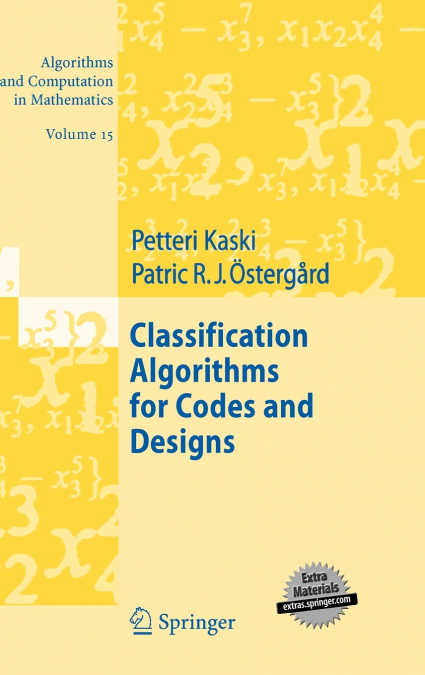
Classification Algorithms for Codes and Designs

Classification Algorithms for Codes and Designs

Patric R.J. Östergård / Petteri Kaski

156,51 €
IVA incluido
Consulta disponibilidad
Editorial:
Springer Nature B.V.
Año de edición:
2005
ISBN:
9783540289906

Selecciona una librería:

  • Librería Samer Atenea
  • Librería Aciertas (Toledo)
  • Kálamo Books
  • Librería Perelló (Valencia)
  • Librería Elías (Asturias)
  • Donde los libros
  • Librería Kolima (Madrid)
  • Librería Proteo (Málaga)

A new starting-point and a new method are requisite, to insure a complete [classi?cation of the Steiner triple systems of order 15]. This method was furnished, and its tedious and di?cult execution und- taken, by Mr. Cole. F. N. Cole, L. D. Cummings, and H. S. White (1917) [129] The history of classifying combinatorial objects is as old as the history of the objects themselves. In the mid-19th century, Kirkman, Steiner, and others became the fathers of modern combinatorics, and their work - on various objects, including (what became later known as) Steiner triple systems - led to several classi?cation results. Almost a century earlier, in 1782, Euler [180] published some results on classifying small Latin squares, but for the ?rst few steps in this direction one should actually go at least as far back as ancient Greece and the proof that there are exactly ?ve Platonic solids. One of the most remarkable achievements in the early, pre-computer era is the classi?cation of the Steiner triple systems of order 15, quoted above. An onerous task that, today, no sensible person would attempt by hand calcu- tion. Because, with the exception of occasional parameters for which com- natorial arguments are e?ective (often to prove nonexistence or uniqueness), classi?cation in general is about algorithms and computation.

Artículos relacionados

  • Transformation of Knowledge, Information and Data
    Patrick Van Bommel
    ...
  • Advanced Geospatial Practices in Natural Environment Resource Management
    Today, the relentless depletion of natural resources has reached a critical juncture, demanding innovative solutions. Advanced Geospatial Practices in Natural Environment Resource Management dives into the intricate tapestry of issues jeopardizing ecosystems. This book systematically dissects the fundamental drivers, traces the historical evolution, and elucidates the underlyin...
  • Advanced Geospatial Practices in Natural Environment Resource Management
    Today, the relentless depletion of natural resources has reached a critical juncture, demanding innovative solutions. Advanced Geospatial Practices in Natural Environment Resource Management dives into the intricate tapestry of issues jeopardizing ecosystems. This book systematically dissects the fundamental drivers, traces the historical evolution, and elucidates the underlyin...
    Disponible

    274,88 €

  • Accelerate Model Training with PyTorch 2.X
    Maicon Melo Alves
    Dramatically accelerate the building process of complex models using PyTorch to extract the best performance from any computing environmentKey Features- Reduce the model-building time by applying optimization techniques and approaches- Harness the computing power of multiple devices and machines to boost the training process- Focus on model quality by quickly evaluating differe...
    Disponible

    64,00 €

  • Information Theory for Data Science
    Changho Suh
    Information theory deals with mathematical laws that govern the flow, representation and transmission of information, just as the field of physics concerns laws that govern the behavior of the physical universe. The foundation was made in the context of communication while characterizing the fundamental limits of communication and offering codes (sometimes called algorithms) to...
  • Theory of Decision Under Uncertainty
    Itzhak Gilboa
    ...
    Disponible

    49,52 €

Otros libros del autor

  • Classification Algorithms for Codes and Designs
    Patric R.J. Östergård / Petteri Kaski
    A new starting-point and a new method are requisite, to insure a complete [classi?cation of the Steiner triple systems of order 15]. This method was furnished, and its tedious and di?cult execution und- taken, by Mr. Cole. F. N. Cole, L. D. Cummings, and H. S. White (1917) [129] The history of classifying combinatorial objects is as old as the history of the objects themselves....
    Disponible

    157,86 €