 Librería Samer Atenea
 Kálamo Books
 Librería Elías (Asturias)
 Librería Kolima (Madrid)
 Librería Proteo (Málaga)
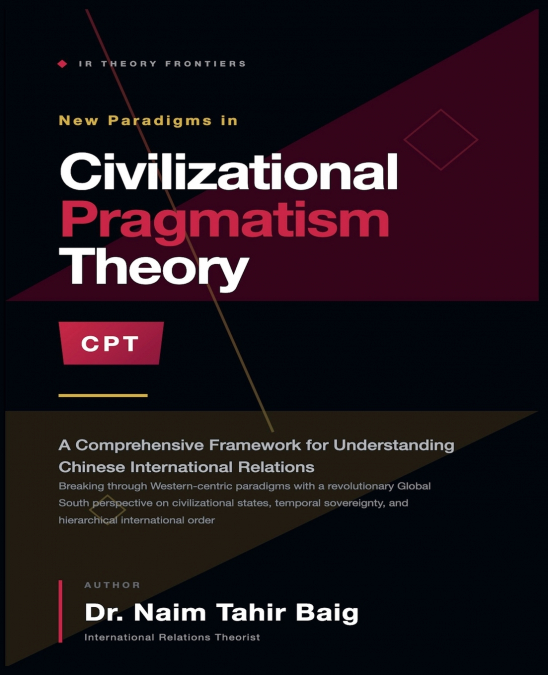
BOOK DESCRIPTIONCivilizational Pragmatism Theory (CPT): A Comprehensive Framework for Understanding Chinese International RelationsA Paradigm-Shifting Analysis of China’s Rise and the Future of Global OrderCivilizational Pragmatism Theory represents a departure from failed paradigms. Drawing on ten years of rigorous empirical research, Dr. Naim Tahir Baig-a Pakistani scholar uniquely positioned at the intersection of Islamic, Chinese, and Western civilizations-presents the first comprehensive non-Western theoretical framework for understanding China as a civilizational state rather than a conventional nation-state. Building on the pioneering work of scholars like Zhang Weiwei, Martin Jacques, and Christopher Coker on civilizational states, and informed by Chinese intellectuals such as Yan Xuetong, Zhao Tingyang, and Qin Yaqing who have developed distinctly Chinese approaches to international relations, this book establishes CPT as a rigorous, operationalizable, and predictively powerful alternative to Western-centric theories.At the heart of CPT lies a fundamental insight: China’s foreign policy is best understood not through the lens of short-term power maximization or institutional integration, but as a multi-generational project of civilizational restoration. The theory introduces four core axioms-Civilizational Restoration Imperative, Temporal Arbitrage, Hierarchical Harmony, and Strategic Paradox-that explain behaviors from Beijing’s patient approach to Taiwan reunification to its simultaneous pursuit of economic integration and strategic autonomy, from its creation of parallel international institutions like the Asian Infrastructure Investment Bank to its 'Wolf Warrior' diplomatic assertiveness under Xi Jinping.The book systematically dismantles the predictive failures of realism, liberalism, constructivism, and power transition theory while constructing a sophisticated alternative framework. CPT operationalizes previously vague concepts like 'civilizational identity' and 'strategic culture' into measurable variables with demonstrated statistical significance. The theory’s predictive accuracy is validated through rigorous hypothesis testing, process tracing of critical cases including the South China Sea disputes, the U.S.-China trade war, COVID-19 diplomacy, and China’s response to the Russia-Ukraine conflict, and comparative analysis with alternative theoretical frameworks.Key FeaturesTheoretical Innovation:First comprehensive non-Western framework for analyzing great power behaviorOperationalizes civilizational variables with rigorous quantitative measurementIntegrates insights from Chinese, Islamic, and South Asian intellectual traditionsEmpirical Depth:Analysis of 200,000+ data points across diplomatic, economic, and military domainsMulti-archival research drawing on Chinese, Pakistani, and Western sourcesExtensive case studies from South China Sea to Belt and Road Initiative to U.S.-China strategic competitionPolicy Relevance:Strategic recommendations for the United States, regional powers, and developing nationsCrisis prevention frameworks for Taiwan, South China Sea, and trade disputesFour detailed future scenarios with probability assessments through 2050Global Scope:Comparative analysis of China, India, Iran, Turkey, and Russia as civilizational statesAssessment of Belt and Road Initiative impacts across Asia, Africa, Latin America, and Middle EastExamination of China’s relations with all major powers and key regional statesImplications for global governance, economic order, and security architecture