

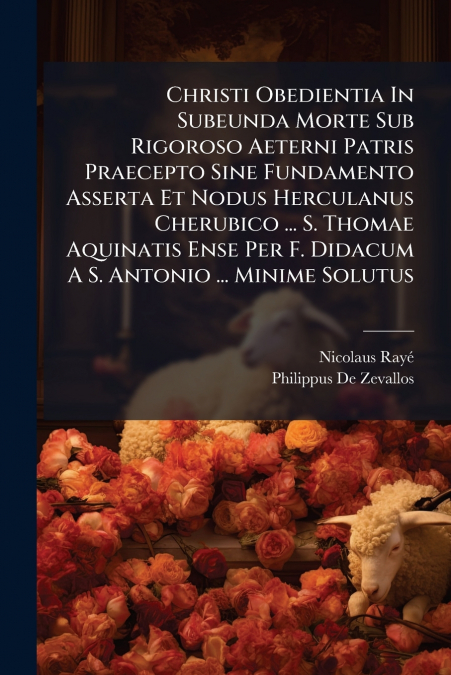
Nicolaus Rayé (S.J.) / Philippus De Zevallos
 Librería Samer Atenea
 Kálamo Books
 Librería Elías (Asturias)
 Librería Kolima (Madrid)
 Librería Proteo (Málaga)
This historical theological treatise, 'Christi Obedientia In Subeunda Morte Sub Rigoroso Aeterni Patris Praecepto Sine Fundamento Asserta Et Nodus Herculanus Cherubico ... S. Thomae Aquinatis Ense Per F. Didacum A S. Antonio ... Minime Solutus,' explores the concept of Christ’s obedience in undergoing death under the rigorous precept of the Eternal Father. Authored by Nicolaus Rayé (S.J.) and Philippus De Zevallos, the work engages with the theological arguments surrounding the nature and foundation of this obedience. The text presents a detailed examination of the subject, asserting its claims and engaging with the ideas of prominent theological figures such as St. Thomas Aquinas. This volume offers valuable insights into 17th-century theological debates within the Catholic tradition, particularly concerning soteriology and the understanding of Christ’s sacrifice.This work has been selected by scholars as being culturally important, and is part of the knowledge base of civilization as we know it. This work was reproduced from the original artifact, and remains as true to the original work as possible. Therefore, you will see the original copyright references, library stamps (as most of these works have been housed in our most important libraries around the world), and other notations in the work.This work is in the public domain in the United States of America, and possibly other nations. Within the United States, you may freely copy and distribute this work, as no entity (individual or corporate) has a copyright on the body of the work.As a reproduction of a historical artifact, this work may contain missing or blurred pages, poor pictures, errant marks, etc. Scholars believe, and we concur, that this work is important enough to be preserved, reproduced, and made generally available to the public. We appreciate your support of the preservation process, and thank you for being an important part of keeping this knowledge alive and relevant.





