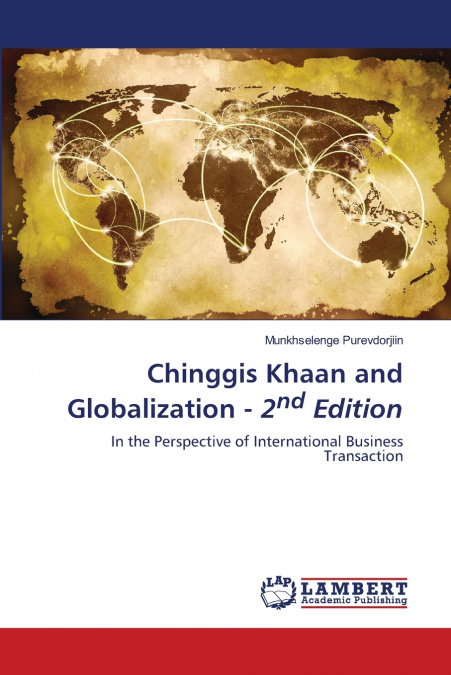

Chinggis Khaan and Globalization - 2nd Edition

Chinggis Khaan and Globalization - 2nd Edition

Munkhselenge Purevdorjiin

65,93 €
IVA incluido
Disponible
Editorial:
KS OmniScriptum Publishing
Año de edición:
2025
ISBN:
9786208462734
65,93 €
IVA incluido
Disponible

Selecciona una librería:

  • Librería Samer Atenea
  • Librería Aciertas (Toledo)
  • Kálamo Books
  • Librería Perelló (Valencia)
  • Librería Elías (Asturias)
  • Donde los libros
  • Librería Kolima (Madrid)
  • Librería Proteo (Málaga)

Globalization has spread broadly and has been recognized in the world at the present time. The United Nations ESCWA says that globalization is not a new phenomenon. It began towards the end of the 19th century, but it slowed down during the period from the start of the First World War until the third quarter of the 20th century. This slowdown can be attributed to the inward-looking policies pursued by a number of countries in order to protect their respective industries. However, the pace of globalization picked up rapidly during the fourth quarter of the 20th century . . . Another resource says that since its inception, the concept of globalization has inspired numerous competing definitions and interpretations, with antecedents dating back to the great movements of trade and empire across Asia and the Indian Ocean from the 15th century onwards. But did globalization exist before the 15th century? Could it be said that globalization had existed during the Great Chinggis Khaan’s conquest of the world in the 13th century?
Artículos relacionados

  • Die Rolle der Direktoren in kleinen und mittelständischen Unternehmen
    Rambodh Sharma
    Dieses Buch enthält eine kritische Analyse der Rolle, die Direktoren in kleinen und mittleren Unternehmen (KMU) im Distrikt Raipur im Bundesstaat Chhattisgarh spielen. Als integrale Entscheidungsträger haben Direktoren erheblichen Einfluss auf die strategische Ausrichtung und die betriebliche Effizienz von KMU, die eine entscheidende Rolle für die wirtschaftliche Entwicklung de...
    Disponible

    105,07 €

  • Регулирование нефтяной промышленности в Нигерии
    ЭдоАбаси Удо
    Нефтяная промышленность - это источник жизненной силы нигерийской экономики. По официальным данным бюджетного управления Федеративной Республики Нигерия, на долю этой отрасли приходится около 29,1% ВВП и 78% всех государственных доходов. Однако за этой статистикой скрывается отрасль, чреватая коррупцией, загрязнением окружающей среды, неполным использованием и потерями, проблем...
    Disponible

    80,17 €

  • A Regulamentação da Indústria Petrolífera na Nigéria
    EdoAbasi Udo
    A indústria petrolífera é a força vital da economia nigeriana. Os registos oficiais do gabinete orçamental da República Federal da Nigéria mostram que a indústria representou cerca de 29,1% do PIB e 78% do total das receitas públicas. No entanto, por detrás destas estatísticas, há uma indústria repleta de corrupção, poluição ambiental, subutilização e desperdícios, problemas de...
    Disponible

    80,20 €

  • La regolamentazione dell’industria petrolifera in Nigeria
    EdoAbasi Udo
    L’industria petrolifera è la linfa vitale dell’economia nigeriana; i dati ufficiali dell’ufficio del bilancio della Repubblica Federale della Nigeria mostrano che l’industria rappresenta circa il 29,1% del PIL e il 78% delle entrate totali del governo. Dietro a queste statistiche, tuttavia, si nasconde un’industria afflitta da corruzione, inquinamento ambientale, sottoutilizzo ...
    Disponible

    80,23 €

  • La réglementation de l’industrie pétrolière au Nigeria
    EdoAbasi Udo
    L’industrie pétrolière est l’élément vital de l’économie nigériane. Les données officielles du bureau du budget de la République fédérale du Nigeria montrent que l’industrie représente environ 29,1 % du PIB et 78 % des recettes totales du gouvernement. Derrière ces statistiques se cache toutefois une industrie marquée par la corruption, la pollution environnementale, la sous-ut...
    Disponible

    80,20 €

  • Die Regulierung der Erdölindustrie in Nigeria
    EdoAbasi Udo
    Die Erdölindustrie ist der Lebensnerv der nigerianischen Wirtschaft. Offizielle Aufzeichnungen des Haushaltsamtes der Bundesrepublik Nigeria zeigen, dass die Industrie etwa 29,1 % des BIP und 78 % der gesamten Staatseinnahmen ausmacht. Hinter diesen Statistiken verbirgt sich jedoch eine Industrie, die mit Korruption, Umweltverschmutzung, unzureichender Nutzung und Verschwendung...
    Disponible

    80,18 €