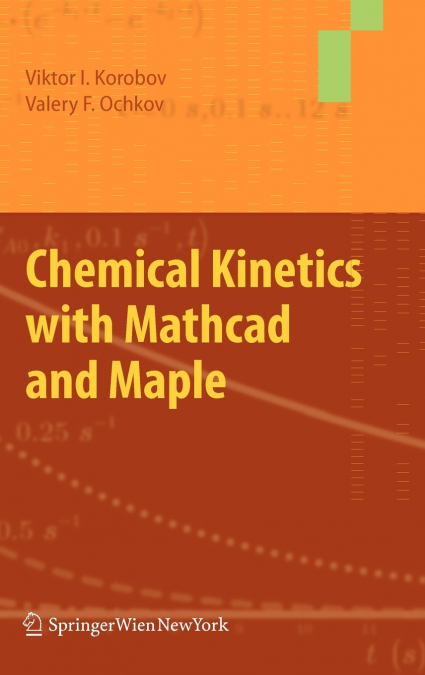
Valery Ochkov / Viktor Korobov
 Librería Samer Atenea
 Kálamo Books
 Librería Elías (Asturias)
 Librería Kolima (Madrid)
 Librería Proteo (Málaga)
ForewordChapter 1. Formally-kinetic description of one- and two-step reactions1.1 Main concepts of chemical kinetics1.2 Kinetics of simple reactions1.3 Reactions, which include two elementary steps1.3.1 Reversible (two-way) reactions1.3.2 Consecutive reactions1.3.3 Parallel reactions1.3.4 Simplest self-catalyzed reaction Chapter 2. Multi-step reactions: the methods for analytical solving the direct problem2.1 Developing a mathematical model of a reaction2.2 The classical matrix method for solving the direct kinetic problem2.3 The Laplace transform in kinetic calculations2.3.1 Brief notes from operational calculus2.3.2 Derivation of kinetic equations for linear sequences of first-order reactions2.3.3 Transient regime in a system of flow reactors2.3.4 Kinetic models in the form of equations containing piecewise continuous functions2.4 Approximate methods of chemical kinetics2.4.1 The steady-state concentration method2.4.2 The quasi-equilibrium approximation. Enzymatic reaction kineticsChapter 3. Numerical solution of the direct problem in chemical kinetics3.1 Given/Odesolve solver in Mathcad system3.2 Built-in Mathcad integrators3.3 The Maple system commands dsolve, odeplot in numerical calculations3.4 Oscillation processes modeling3.5 Some points on non-isothermal kineticsChapter 4. Inverse chemical kinetics problem4.1 Features of the inverse problem4.2 Determination of kinetic parameters using data linearization4.2.1 Hydrolysis of methyl acetate in acidic media4.2.2 Butadiene dimerization: finding the reaction order and the rate constant4.2.3 Exclusion of time as an independent variable4.2.4 Linearization with numerical integration of kinetic data. Basic hydrolysis of diethyl adipate4.2.5. Estimation of confidence intervals for the calculated constants4.2.6 Kinetics of α-pinene isomerization4.3 Inverse problem and specialized minimization methods4.3.1 Deriving parameters for an empirical rate equation of phosgene synthesis4.3.2 Kinetics of trans-stilbene isomerization4.3.3 Kinetics of stepwise ligand exchange in chrome complexes4.4 Computing kinetic parameters using non-linear approximation tools4.5 Universal approaches to inverse chemical kinetics problem4.5.1 Reversible reaction with dimerization of an intermediate4.5.2 Thermal decomposition of disilaneChapter 5. Introduction into electrochemical kinetics5.1 General features of electrode processes5.2 Kinetics of the slow discharge-ionization step5.3 Electrochemical reactions with stepwise electron transfer5.4 Electrode processes under slow diffusion conditions5.4.1 Relationship between rate and potential under stationary diffusion5.4.2 Nonstationary linear diffusion to a planar electrode under electrostatic conditions5.4.3 Nonstationary diffusion to a spherical electrode under potentiostatic conditions5.4.4 Nonstationary diffusion under galvanostatic conditionsChapter 6. Interface of Mathcad 15 and Mathcad Prime6.1 Input/displaying of data6.2 VFO (Variable-Function-Operator)6.2.1 Function and operator6.2.2 Variable name6.2.3 Invisible variableExample 1. Invisible additionExample 2. Zero dimension quantityExample 3. The Roman arithmeticExample 4. The sparse matrixExample 5. Displaying a dimensional value in several unitsExample 6. An endless loopExample 7. A Mathcad user’s dream6.3 Comments in Mathcad worksheets6.4 Calculation with physical quantities: problems and solutions6.5 Three dimensions of Mathcad worksheets6.6 Mathcad plots6.7