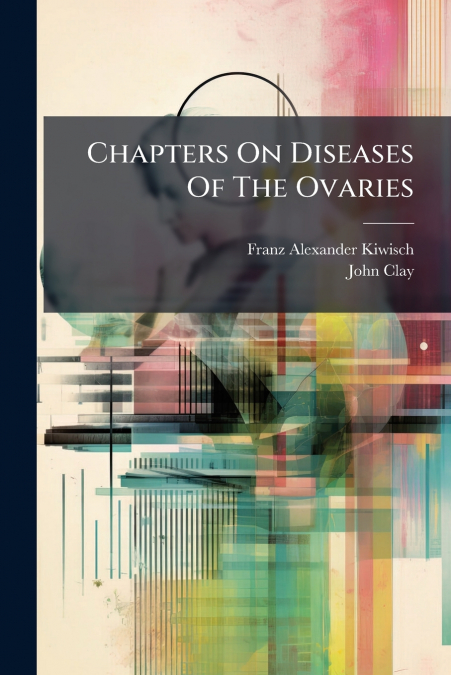
John Clay / Franz Alexander Kiwisch (Ritter von Rott
 Librería Samer Atenea
 Kálamo Books
 Librería Elías (Asturias)
 Librería Kolima (Madrid)
 Librería Proteo (Málaga)
'Chapters On Diseases Of The Ovaries' offers a detailed exploration of ovarian diseases, drawn from Kiwisch’s clinical lectures on the special pathology and treatment of diseases affecting women. This historical text provides insights into 19th-century gynecological practices and understanding. The book includes notes and an appendix focusing on the surgical operation of ovariotomy, offering a comprehensive view of the medical approaches of the time.This edition, translated and adapted by John Clay, makes Kiwisch’s lectures accessible to a broader audience, preserving the original content while adding valuable context and commentary. It serves as a valuable resource for those interested in the history of medicine, particularly the evolution of gynecological treatments and surgical techniques. The detailed descriptions and clinical observations provide a window into the challenges and advancements in women’s healthcare during this era.This work has been selected by scholars as being culturally important, and is part of the knowledge base of civilization as we know it. This work was reproduced from the original artifact, and remains as true to the original work as possible. Therefore, you will see the original copyright references, library stamps (as most of these works have been housed in our most important libraries around the world), and other notations in the work.This work is in the public domain in the United States of America, and possibly other nations. Within the United States, you may freely copy and distribute this work, as no entity (individual or corporate) has a copyright on the body of the work.As a reproduction of a historical artifact, this work may contain missing or blurred pages, poor pictures, errant marks, etc. Scholars believe, and we concur, that this work is important enough to be preserved, reproduced, and made generally available to the public. We appreciate your support of the preservation process, and thank you for being an important part of keeping this knowledge alive and relevant.