 Librería Samer Atenea
 Kálamo Books
 Librería Elías (Asturias)
 Librería Kolima (Madrid)
 Librería Proteo (Málaga)
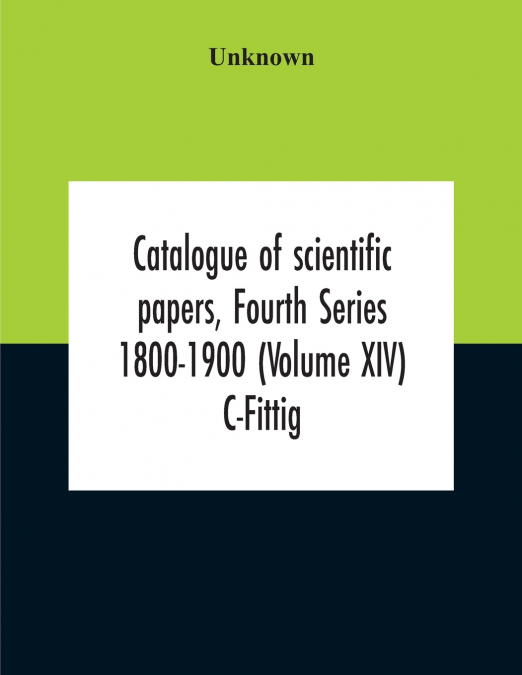
A single shelf that maps a century of discovery. A meticulous guide for scholars. Catalogue Of Scientific Papers, Fourth Series 1800-1900 (Volume Xiv) C-Fittig organises the published record of nineteenth century science into a systematic flow of citations and subject headings. As a scientific papers collection it offers concise bibliographic entries and clear signposts to original articles, guiding readers through the journals that carried chemistry, physics and related work. The entries are compact but informative: authors, titles, journals and dates align to form an efficient academic reference anthology useful for citation checks, provenance research and bibliometric overviews.More than a directory, this historical science bibliography reconstructs the networks behind Victorian era publications and the scientific journal archives that sustained them. It is particularly valuable to those working in chemistry research history and to anyone consulting a physics literature index, because it maps successive contributions and publishing venues rather than summarising content. Students, scholars and researchers will use it to locate obscure early reports, to verify references and to place classic scientific works in their intellectual context. Beyond immediate utility, the catalogue is a primary source for historians: it reveals editorial practices, periodical relationships and the shifting terminologies that mark the maturation of disciplines during the nineteenth century.Republished by Alpha Editions in a careful modern edition, this volume preserves the spirit of the original while making it effortless to enjoy today - a heritage title prepared for readers and collectors alike. Accessible to curious readers yet prized by classic-literature collectors, it belongs on the shelves of university libraries as a dependable university library resource, in reference rooms and in private collections that value primary materials. Whether consulted as a quick reference by scholars and researchers or savoured by science history enthusiasts tracing the genealogy of ideas, this catalogue remains a quiet but essential companion to anyone interested in the architecture of nineteenth century scientific communication.