

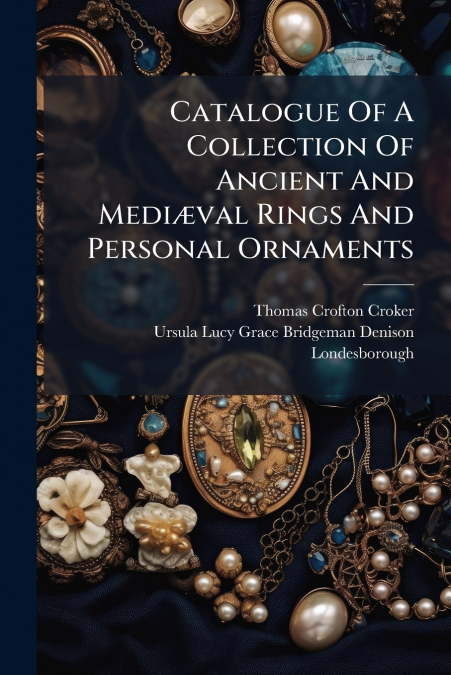
Thomas Crofton Croker / Ursula Lucy Grace Bridgeman Denison Lon
 Librería Samer Atenea
 Kálamo Books
 Librería Elías (Asturias)
 Librería Kolima (Madrid)
 Librería Proteo (Málaga)
This is a meticulously compiled catalogue of ancient and mediæval rings and personal ornaments, a collection formed for Lady Londesborough. This catalogue offers a detailed exploration of the jewelry and adornments of bygone eras. Prepared with scholarly precision by Thomas Crofton Croker, it provides invaluable insights into the styles, materials, and craftsmanship prevalent during ancient and mediæval times. The catalogue includes descriptions of each item, potentially accompanied by illustrations, making it an essential resource for collectors, historians, and anyone with an interest in the decorative arts and social history as reflected in personal adornments. This historical record preserves the legacy of Lady Londesborough’s collection, ensuring its enduring value for future generations.This work has been selected by scholars as being culturally important, and is part of the knowledge base of civilization as we know it. This work was reproduced from the original artifact, and remains as true to the original work as possible. Therefore, you will see the original copyright references, library stamps (as most of these works have been housed in our most important libraries around the world), and other notations in the work.This work is in the public domain in the United States of America, and possibly other nations. Within the United States, you may freely copy and distribute this work, as no entity (individual or corporate) has a copyright on the body of the work.As a reproduction of a historical artifact, this work may contain missing or blurred pages, poor pictures, errant marks, etc. Scholars believe, and we concur, that this work is important enough to be preserved, reproduced, and made generally available to the public. We appreciate your support of the preservation process, and thank you for being an important part of keeping this knowledge alive and relevant.





