
Cartesianism

Cartesianism

Pons Malleus

13,12 €
IVA incluido
Disponible
Editorial:
Pons Malleus
Año de edición:
2026
Materia
Filosofía
ISBN:
9798232546540
13,12 €
IVA incluido
Disponible

Selecciona una librería:

  • Librería Samer Atenea
  • Librería Aciertas (Toledo)
  • Kálamo Books
  • Librería Perelló (Valencia)
  • Librería Elías (Asturias)
  • Donde los libros
  • Librería Kolima (Madrid)
  • Librería Proteo (Málaga)

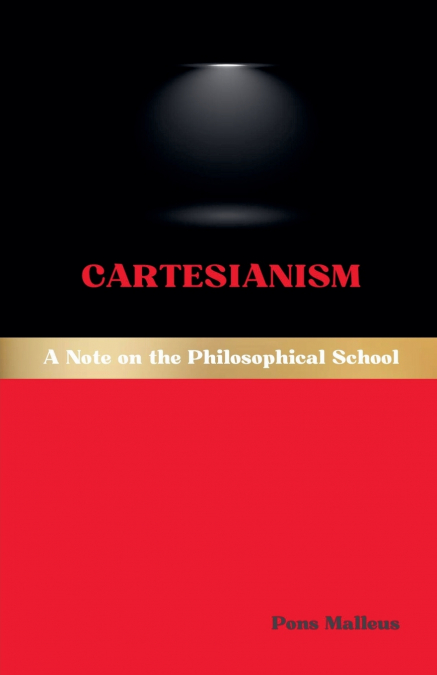
The story of Western philosophy cannot be told without acknowledging a decisive turning point in the 17th century-a moment when doubt became a tool, reason became sovereign, and the self emerged as the foundation of knowledge. At the center of this transformation stands René Descartes, the father of modern philosophy, whose work gave rise to the school of thought known as Cartesianism. This book is dedicated to exploring that philosophical tradition-not merely as a historical phenomenon, but as a living and provocative approach to some of the most enduring questions of human existence.Cartesianism begins with a radical proposal: to doubt everything that can be doubted in order to arrive at something that cannot. It is from this method of systematic skepticism that Descartes arrives at his most famous conclusion: Cogito, ergo sum-'I think, therefore I am.' From that seemingly modest insight, Descartes builds an entire philosophical system, one that seeks certainty in a world filled with uncertainty. He distinguishes the thinking mind (res cogitans) from the extended body (res extensa), introduces a dualistic view of human nature, and grounds knowledge in reason rather than the senses.But Cartesianism is not simply the philosophy of Descartes. It is a tradition that grew, evolved, and was contested by his contemporaries and successors. Figures such as Nicolas Malebranche, Baruch Spinoza, and Antoine Arnauld developed, challenged, or reinterpreted Descartes’ ideas, pushing the boundaries of Cartesian dualism, causality, and the relationship between God, mind, and matter. Even critics of Cartesianism, such as empiricists and existentialists, often define themselves in contrast to its premises.This book offers a comprehensive account of Cartesianism as both a historical movement and a philosophical framework. The aim is twofold: to provide a clear exposition of Cartesian principles, and to trace their influence on later developments in metaphysics, epistemology, science, and philosophy of mind. The first part of the book introduces the life and context of Descartes, the scientific revolution in which he was immersed, and the intellectual problems he sought to address. The second part dives into the key doctrines of Cartesianism, including the method of doubt, the mind-body problem, the idea of innate knowledge, and Descartes’ arguments for the existence of God. The third part follows the trajectory of Cartesian thought beyond Descartes, exploring its impact and its critics, and considering its relevance in contemporary debates about consciousness, artificial intelligence, and the nature of the self.This is not a book solely for scholars. It is intended for anyone who has ever paused to wonder whether the world they perceive is real, whether the mind can be known apart from the body, or whether certainty is possible in a world governed by doubt. Cartesianism invites us to reconsider the foundations of our beliefs, to question appearances, and to trust in the clarity of reason. Whether one accepts its conclusions or not, its questions remain vital.To study Cartesianism is to enter into a conversation that has lasted centuries-a conversation about the nature of thought, the limits of knowledge, and the essence of what it means to be human. This book is an invitation to that conversation.

Artículos relacionados

  • Introduction to a Future Way of Thought
    Kostas Axelos / Kenneth Mills
    'Technologists only change the world in various ways in generalized indifference; the point is to think the world and interpret the changes in its unfathomability, to perceive and experience the difference binding being to the nothing.'Anticipating the age of planetary technology Kostas Axelos, a Greek-French philosopher, approaches the technological question in this book, firs...
    Disponible

    18,58 €

  • Capsule
    John Kenneth Press
    Join John and Adam as they wander the mean streets of Japan on a psychedelic fueled search for identity. While fun for the average reader, this book could also serve as a philosphy textbook because of its ordered exploration of sources of identity. Ultimately this trip through nationalist attacks, sex, and drugs, will take you to a better understanding of yourself and your pl...
    Disponible

    11,51 €

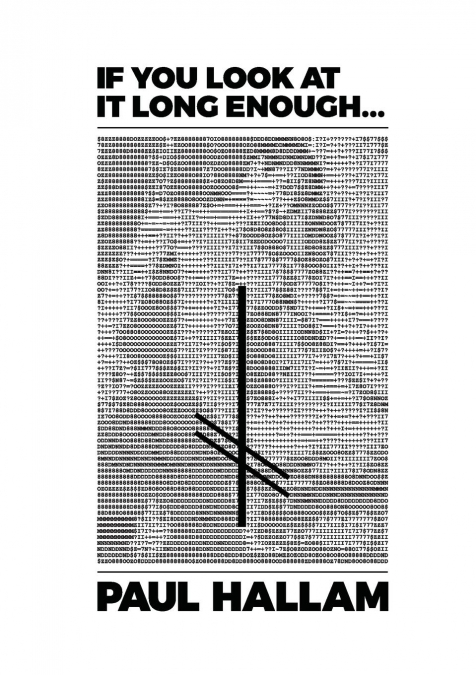
  • If you look at it long enough...
    Paul Hallam
    Originally written for an academic journal, If you look at it long enough... is primarily a personal account of Paul Hallam’s recollections of “self-abuse” through the consumption of porn over several decades. Challenging the familiar form of an “academic essay,” this autobiographical narrative raises several questions in relation to our contemporary morals related to sex in ge...
    Disponible

    11,30 €

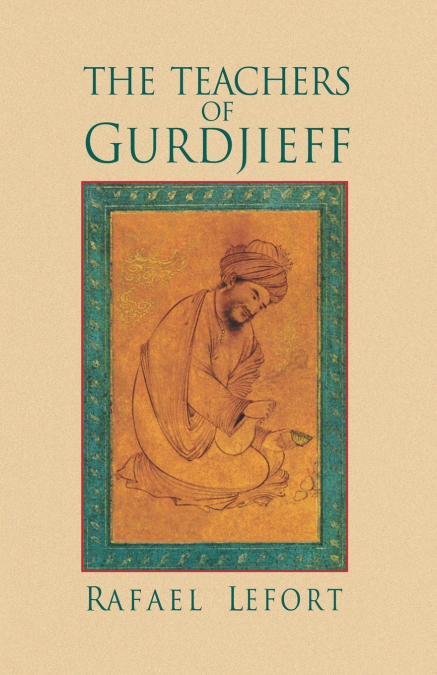
  • The Teachers of Gurdjieff
    Rafael Lafort / Rafael Lefort
    When The Teachers of Gurdjieff was first published more than 50 years ago, it made a considerable stir. George Ivanovich Gurdjieff had been one of the most famous mystics in the West in the first half of the 20th century - a teaching master who had many fashionable and influential pupils. He had a striking appearance and manner of teaching, and his teaching proved to be very in...
    Disponible

    20,45 €

  • Manifesto of the Communist Party
    Karl Marx
    The Communist Manifesto was first published on February 21, and it is one of the world’s most influential political tracts. Commissioned by the Communist League and written by communist theorists Karl Marx and Friedrich Engels, it laid out the League’s purposes and program. The Manifesto suggested a course of action for a proletarian (working class) revolution to overthrow the ...
    Disponible

    14,22 €

  • The Art of Literature
    Arthur Schopenhauer
    Collected here are eight short essays, On Authorship, On Style, On the Study of Latin, On Men of Learning, On Thinking for Ones Self, On Criticism, On Reputation, On Genius, by the world renowned philosopher Arthur Achopenhauer. ...
    Disponible

    20,54 €

Otros libros del autor

  • Coherentism
    Pons Malleus
    In the sphere of epistemology-the branch of philosophy concerned with the nature and scope of knowledge-few debates have been as enduring or as foundational as the one surrounding the justification of belief. Among the competing theories that attempt to explain how our beliefs are supported and validated, Coherentism stands as both a provocative and nuanced alternative to more ...
    Disponible

    13,06 €

  • Determinism
    Pons Malleus
    The question of whether our lives are governed by free will or by forces beyond our control has long been a fundamental concern of human thought. At the heart of this inquiry lies the philosophical doctrine known as Determinism-a worldview asserting that every event, including human actions and decisions, is the inevitable result of preceding causes. This book embarks on an exp...
    Disponible

    13,27 €

  • Foundationalism
    Pons Malleus
    Philosophy, at its core, is a quest for knowledge and understanding-a rigorous endeavor to explore the nature, scope, and justification of human belief. Among the myriad traditions and schools that have shaped philosophical inquiry, Foundationalism holds a particularly pivotal place. This school of thought, which seeks to ground knowledge on a secure and indubitable basis, has ...
    Disponible

    13,16 €

  • Pragmatism
    Pons Malleus
    Emerging in the late 19th century as a distinctly American philosophical movement, Pragmatism has consistently challenged traditional metaphysical and epistemological assumptions by emphasizing action, experience, and the tangible consequences of ideas. This book embarks on a comprehensive exploration of Pragmatism-not merely as a historical artifact but as a living, evolving t...
    Disponible

    13,12 €

  • Constructivism
    Pons Malleus
    In an age where the pursuit of knowledge is often framed as a quest for objective truth, the philosophical school of Constructivism offers a refreshing and transformative perspective. Constructivism challenges us to reconsider how we understand reality, knowledge, and the very processes by which we come to know. Rather than viewing knowledge as a mirror reflecting an independen...
    Disponible

    13,19 €

  • Naturalism
    Pons Malleus
    Naturalism, as a philosophical worldview, has quietly but powerfully shaped much of modern thought. It underpins the sciences, informs secular ethics, and influences debates about mind, meaning, and morality. Yet despite its widespread impact, Naturalism often operates in the background, assumed rather than articulated, accepted without being fully understood. This book aims to...
    Disponible

    13,22 €