Guadix-Baza (Diócesis). Obispo (1706-17 / Guadix-Baza (Diócesis)Obispo (1706-17 / Juan de Montalbán ((O.P.) / Obispo de Guadix y Baza)
 Librería Samer Atenea
 Kálamo Books
 Librería Elías (Asturias)
 Librería Kolima (Madrid)
 Librería Proteo (Málaga)
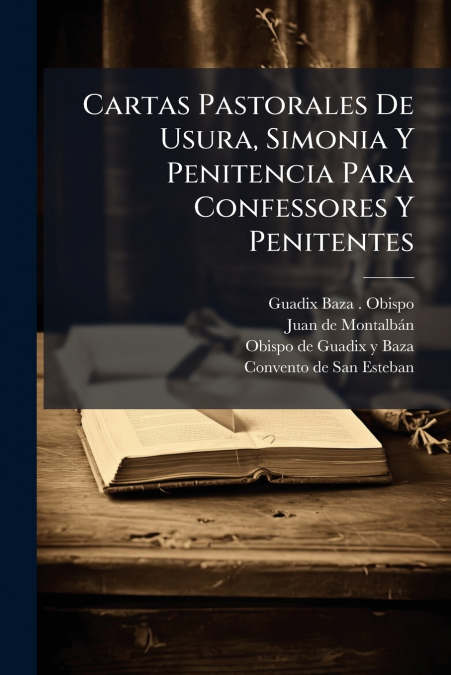
Cartas Pastorales De Usura, Simonia Y Penitencia Para Confessores Y Penitentes is a historical religious text written in Spanish. Authored by Juan de Montalbán, Bishop of Guadix-Baza (1706-1720), and associated with the Convento de San Esteban in Salamanca, these pastoral letters address the critical theological issues of usury, simony, and penitence.This work provides valuable insight into the ethical and moral concerns of the Catholic Church during the period, offering guidance to confessors and penitents alike. The letters serve as a primary source for understanding the practical application of religious doctrine and the lived experiences of individuals navigating these complex spiritual matters. Scholars of religious history, Spanish history, and Catholic theology will find this a compelling and informative resource.This work has been selected by scholars as being culturally important, and is part of the knowledge base of civilization as we know it. This work was reproduced from the original artifact, and remains as true to the original work as possible. Therefore, you will see the original copyright references, library stamps (as most of these works have been housed in our most important libraries around the world), and other notations in the work.This work is in the public domain in the United States of America, and possibly other nations. Within the United States, you may freely copy and distribute this work, as no entity (individual or corporate) has a copyright on the body of the work.As a reproduction of a historical artifact, this work may contain missing or blurred pages, poor pictures, errant marks, etc. Scholars believe, and we concur, that this work is important enough to be preserved, reproduced, and made generally available to the public. We appreciate your support of the preservation process, and thank you for being an important part of keeping this knowledge alive and relevant.