Capital Wars

Capital Wars

Michael J. Howell

68,75 €
IVA incluido
Disponible
Editorial:
Springer Nature B.V.
Año de edición:
2021
Materia
Finanzas
ISBN:
9783030392901
68,75 €
IVA incluido
Disponible

Selecciona una librería:

  • Librería Samer Atenea
  • Librería Aciertas (Toledo)
  • Kálamo Books
  • Librería Perelló (Valencia)
  • Librería Elías (Asturias)
  • Donde los libros
  • Librería Kolima (Madrid)
  • Librería Proteo (Málaga)

Economic cycles are driven by financial flows, namely quantities of savings and credits, and not by high street inflation or interest rates. Their sweeping destructive powers are expressed through Global Liquidity, a $130 trillion pool of footloose cash. Global Liquidity describes the gross flows of credit and international capital feeding through the world’s banking systems and wholesale money markets. The huge jump in the volume of international financial markets since the mid-1980s has been boosted by deregulation, innovation and easy money, with financial globalisation now surpassing the peaks of integration reached before the First World War. Global Liquidity drives these markets: it is often determinant, frequently disruptive and always fast-moving. Barely one fifth of Wall Street’s huge gains over recent decades have come from earnings: rising liquidity and investors’ appetite for riskier financial assets have propelled stock prices higher. Similar experiences are shared worldwide and even in emerging markets, such as India, flat earnings have not deterred waves of foreign money and domestic mutual funds from driving-up stock prices. Now with central banks actively pursuing quantitative easing policies, industrial corporations flush with cash and rising wealth levels among emerging market investors, the liquidity theory of investment has never been more important.International spill-overs of these rapacious cross-border flows sets off capital wars and exposes the unattractive face of liquidity called ’risk.’ As the world grows bigger, it becomes ever more volatile. From the early 1960s onwards, the world economy and its financial markets have suffered from three broad types of shocks - labour costs, oil and commodities, and global liquidity. Financial markets spin on fragile axes and the absence of liquidity often provides a warning of upcoming troubles. Global Liquidity is a much-discussed, but narrowly-researched and vaguely-defined topic. This book deeply explores the subject by clearly defining and measuring liquidity worldwide and by showing its importance for investors. The roles of central banks, shadow banking, the rise of Repo and growth of wholesale money are discussed. Additionally, covering the latest developments in China’s increasingly dominant financial economy, this book will appeal to practitioners, policy-makers, economists and academics, as well as those with a general interest in how financial markets work.


Artículos relacionados

  • Global Perspectives on Risk Management and Accounting in the Public Sector
    The effects of recent economic and financial crises have reached an international scale; a number of different nations have experienced the fallout of these events, calling into question issues of accountability and reform in public management. Global Perspectives on Risk Management and Accounting in the Public Sector is a pivotal reference source for the latest research on cur...
  • Alternative Decision-Making Models for Financial Portfolio Management
    Narela Spaseski
    Economics is an integral aspect to every successful society, yet basic financial practices have gone unchanged for decades. Analyzing unconventional finance methods can provide new ways to ensure personal financial futures on an individual level, as well as boosting international economies. Alternative Decision-Making Models for Financial Portfolio Management: Emerging Research...
  • Multi-Sided Platforms (MSPs) and Sharing Strategies in the Digital Economy
    Sergey Yablonsky
    Rapid technological advancements have the ability to positively or negatively impact corporate growth and success. Professional leaders and decision makers must consider such advancements when designing and implementing new policies in preparation for the sustainable future of the business environment. Multi-Sided Platforms (MSPs) and Sharing Strategies in the Digital Economy: ...
  • The Complete Penny Stock Course
    Jamil Ben Alluch
    You can learn trading penny stocks from the masses and become part of the 90% of traders who lose money in the stock market, or you can learn from the Best. The Complete Penny Stock Course is based on Timothy Sykes’, various training programs. His strategies have helped individuals like Tim Grittani, Michael Goode and Stephen Dux become millionaires within a couple of years.Thi...
    Disponible

    37,63 €

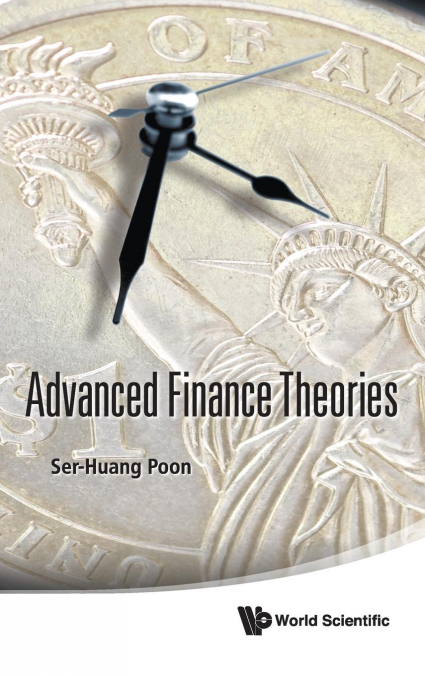
  • ADVANCED FINANCE THEORIES
    POON SER-HUANG / Ser-Huang Poon
    For PhD finance courses in business schools, there is equal emphasis placed on mathematical rigour as well as economic reasoning. Advanced Finance Theories provides modern treatments to five key areas of finance theories in Merton's collection of continuous time work, viz. portfolio selection and capital market theory, optimum consumption and intertemporal portfolio selecti...
  • Jefferson's Nightmare
    William O. Joseph
    Common working people have been getting screwed by the banking industry for hundreds of years. In the United States over 21 million family members have lost their homes since 2007. Millions more have watched their careers go up in smoke. If you think there is nothing wrong with such a system then don't bother to read this book.   Two hundred years ago, Thomas Jefferson ha...
    Disponible

    12,42 €