Librería Samer Atenea
 Kálamo Books
 Librería Elías (Asturias)
 Librería Kolima (Madrid)
 Librería Proteo (Málaga)
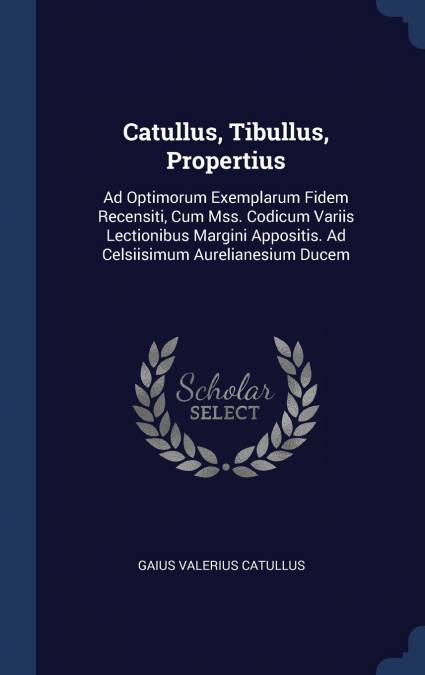
This volume presents a selection of poems by three of Rome’s most celebrated elegiac poets: Catullus, Tibullus, and Propertius. Gaius Valerius Catullus (c. 84 - c. 54 BC) is known for his passionate and often scandalous short poems, ranging from love lyrics to invectives. Albius Tibullus (c. 55 - 19 BC) wrote gentle and melancholy elegies, often focused on love and rural life. Sextus Aurelius Propertius (c. 50 - c. 15 BC) is noted for his complex and allusive love poetry, particularly concerning his relationship with ’Cynthia’. This selection offers a taste of their enduring contributions to Latin literature and provides insights into the social and emotional life of ancient Rome. Ideal for students and enthusiasts of classical poetry, ’C. Valerii Catulli, Albii Tibulli Et Sexti Aurelii Propertii Carmina Selecta’ captures the beauty and sophistication of Latin verse.This work has been selected by scholars as being culturally important, and is part of the knowledge base of civilization as we know it. This work was reproduced from the original artifact, and remains as true to the original work as possible. Therefore, you will see the original copyright references, library stamps (as most of these works have been housed in our most important libraries around the world), and other notations in the work.This work is in the public domain in the United States of America, and possibly other nations. Within the United States, you may freely copy and distribute this work, as no entity (individual or corporate) has a copyright on the body of the work.As a reproduction of a historical artifact, this work may contain missing or blurred pages, poor pictures, errant marks, etc. Scholars believe, and we concur, that this work is important enough to be preserved, reproduced, and made generally available to the public. We appreciate your support of the preservation process, and thank you for being an important part of keeping this knowledge alive and relevant.