
Inicio > Economía, finanzas, empresa y gestión > Economía > Macroeconomía > Business Cycles and Macroeconomic Stability
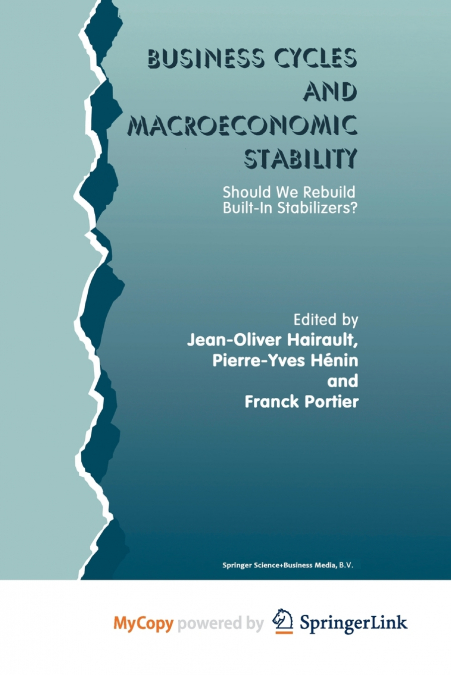
Business Cycles and Macroeconomic Stability

Business Cycles and Macroeconomic Stability


47,46 €
IVA incluido
Disponible
Editorial:
Springer Nature B.V.
Año de edición:
2011
Materia
Macroeconomía
ISBN:
9781461561743
47,46 €
IVA incluido
Disponible

Selecciona una librería:

  • Librería Samer Atenea
  • Librería Aciertas (Toledo)
  • Kálamo Books
  • Librería Perelló (Valencia)
  • Librería Elías (Asturias)
  • Donde los libros
  • Librería Kolima (Madrid)
  • Librería Proteo (Málaga)

Setting the issue 'Most economists consider the marked increase in automatic stabilizers a highly favorable development with respect to maintenance of economic stability'. Besides the rare privilege of having being signed by both Milton Friedman and Paul Samuelson (Depres,Friedman, Hart, Samuelson, and Wallace [1950]), among others, this sentence expressed as soon as 1950 the consensus view on the stabilizing effect of fiscal rules governing tax revenue and public expendi­ tures and transfers. This positive ex ante assessment will have been confirmed ex post as part of the explanation for post war stabilization (Burns [1960], de Long and Summers [1986], Moore and Zarnovitz [1986]). However, it becomes disputed in both its positive and normative aspects. Many institutional changes since the eighties point at curbing back the transfer mechanisms underlying automatic stabilizers, and legal restraints on deficits such as the US balanced budget amendment or the European Maastricht criteria would involve serious risks for the future of stabilizers. Under such rules 'the government would become, almost inevitally, a destabilizer rather than a stabilizer' said Joseph Stiglitz, quoted by the New York Times (April 1995)). 'Built-in stabilizers are automatic fiscal adjustments that reduce the national income multiplier and thus cushion the effects of changes in autonomous spend­ ing on the level of income' (Pechman [1987]). Early analyses of the automatic fiscal stabilizers include the contributions of A. G. Hart [1945], R. Musgrave and M. Miller (1948) and E. C. Brown (1955).
Artículos relacionados

  • Introduction to Dynamic Macroeconomic General Equilibrium Models
    José Luis Torres Chacon
    This book offers an introductory step-by-step course in Dynamic Stochastic General Equilibrium modelling. Modern macroeconomic analysis is increasingly concerned with the construction, calibration and/or estimation and simulation of Dynamic General Equilibrium (DGE) models. The book is intended for graduate students as an introductory course to DGE modelling and for those econo...
    Disponible

    61,40 €

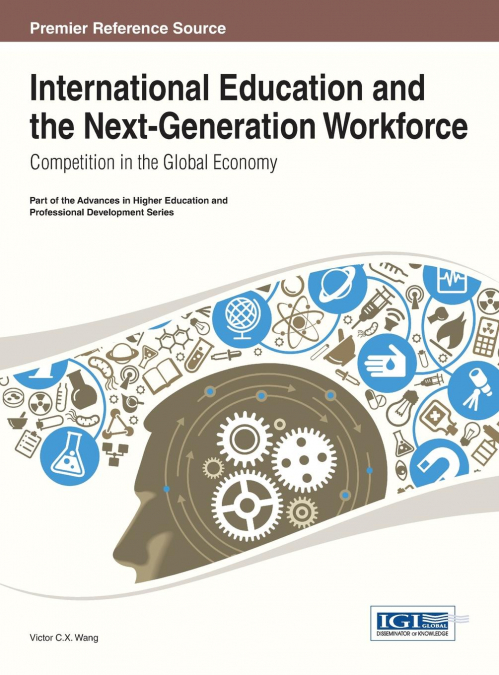
  • International Education and the Next-Generation Workforce
    Wei Wang
    Education is the first stage in developing a viable, dynamic, and long-lived global economy. Unfortunately, in times of economic hardship, educational programs, teacher salaries, and extracurricular opportunities are often the first to be cut. International Education and the Next-Generation Workforce: Competition in the Global Economy presents a detailed discussion of present e...
  • Macroeconomic Policies of Developed Democracies
    Robert J Franzese Jr
    ...
  • End Of The Road
    Louis Holder
    This book is about the mismanagement of Western economies in pursuit of political power, which resulting devastation will have to be borne by future generations. The book establishes that postponement is no longer doable and lays out the hard choices ahead causing much misery and agony.Although not fully recognized because of masking by asset bubbles, which are spun/sold as in...
    Disponible

    16,42 €

  • The Darwin Economy
    Robert H. Frank
    What Charles Darwin can teach us about building a fairer societyWho was the greater economist-Adam Smith or Charles Darwin? The question seems absurd. Darwin, after all, was a naturalist, not an economist. But Robert Frank, New York Times economics columnist and best-selling author of The Economic Naturalist, predicts that within the next century Darwin will unseat Smith as the...
    Disponible

    22,42 €

  • Myth and Measurement
    Alan B. Krueger / David Card
    From David Card, winner of the Nobel Prize in Economics, and Alan Krueger, a provocative challenge to conventional wisdom about the minimum wageDavid Card and Alan B. Krueger have already made national news with their pathbreaking research on the minimum wage. Here they present a powerful new challenge to the conventional view that higher minimum wages reduce jobs for low-wage ...
    Disponible

    39,64 €