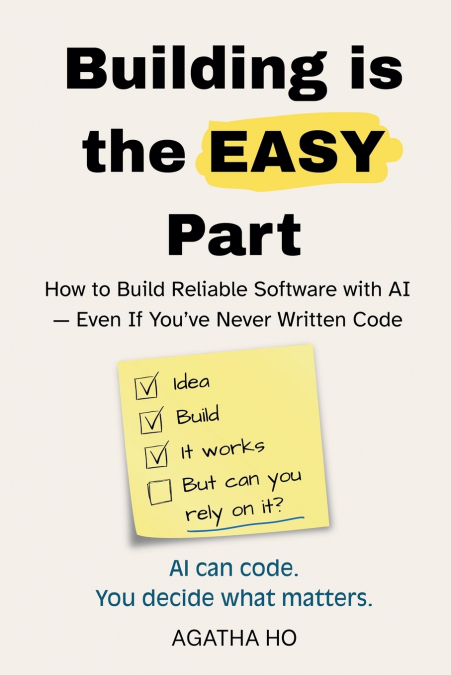

Building Is the Easy Part

Building Is the Easy Part

Agatha Ho

22,04 €
IVA incluido
Disponible
Editorial:
Agatha Ho
Año de edición:
2026
Materia
Programación informática/desarrollo de software
ISBN:
9789887264118
22,04 €
IVA incluido
Disponible

Selecciona una librería:

  • Librería Samer Atenea

  • Kálamo Books
  • Librería Elías (Asturias)
  • Librería Kolima (Madrid)
  • Librería Proteo (Málaga)

AI can write the code. But how do you know the software it builds actually works the way it should?You no longer need to be a programmer to build software.Describe what you want, and AI can generate features, fix bugs, make changes, and turn an idea into working software faster than ever before.But there’s a problem.A feature can work exactly as requested and still be wrong.AI can make a change that fixes one problem while quietly creating another. It can make assumptions you never approved, produce tests that appear to pass, and confidently tell you something works when the evidence says otherwise.When AI is doing work you may not know how to do yourself, how do you know what to trust?Building Is the Easy Part gives you a practical foundation for building reliable software with AI-even if you’ve never written code.You’ll learn how to:Start with the problem, then turn what must be true into clear requirements and behavior AI can build fromDecide what AI may do and which decisions still require human judgmentGive AI reliable project context without depending on conversation history as your project recordKeep track of what changed, why it changed, and the decisions and evidence behind itTest what the software actually does instead of accepting AI’s claim that it worksLook for unintended effects when a change reaches beyond the feature you meant to modifyJudge what the evidence supports, what remains uncertain, and whether you have enough confidence to proceedApply stronger controls as the consequences increase-and recognize when qualified human expertise is requiredMake deliberate decisions about acceptance, release, recovery, and what happens after the software is in useThis isn’t a book about memorizing programming languages or learning to write code yourself.It’s about learning how to direct the work, examine the evidence, and retain authority over what gets built while AI carries more of the technical execution.You don’t need to know everything the AI knows. You need to understand the purpose, evidence, consequences, and decisions surrounding the work well enough to decide what happens next.AI has made it possible for almost anyone to build software.The question is no longer whether you can build it. It’s whether you know how to build something you can trust.
Artículos relacionados

  • SPARK 2014 Reference Manual
    AdaCore / Altran UK Ltd
    SPARK 2014 is a programming language and a set of verification tools designed to meet the needs of high-assurance software development. SPARK 2014 is based on Ada 2012, both subsetting the language to remove features that defy verification, but also extending the system of contracts and aspects to support modular, formal verification.This manual is available online for free at ...
    Disponible

    19,91 €

  • Software and Intelligent Sciences
    Yingxu Wang
    The junction of software development and engineering combined with the study of intelligence has created a bustling intersection of theory, design, engineering, and conceptual thought. Software and Intelligent Sciences: New Transdisciplinary Findings sits at a crossroads and informs advanced researchers, students, and practitioners on the developments in computer science, theor...
  • Power System Planning Technologies and Applications
    Fawwaz Elkarmi / Nazih Abu Shikhah / Nazih Abu-Shikhah
    Planning is an important function of the management of any business, providing knowledge of future prospects and enabling prudent and appropriate decision-making. Planning is especially critical for power systems, since electricity is a fundamental part of modern societies and many conventional electrical energy resources currently in use are limited. Power System Planning Tech...
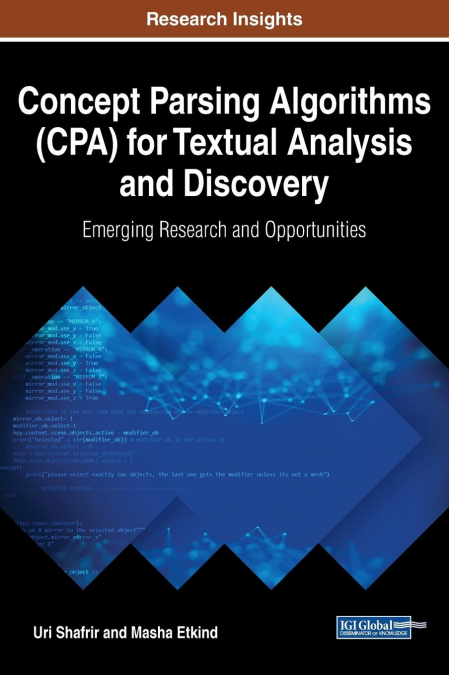
  • Concept Parsing Algorithms (CPA) for Textual Analysis and Discovery
    Masha Etkind / Uri Shafrir
    Text analysis tools aid in extracting meaning from digital content. As digital text becomes more and more complex, new techniques are needed to understand conceptual structure. Concept Parsing Algorithms (CPA) for Textual Analysis and Discovery: Emerging Research and Opportunities provides an innovative perspective on the application of algorithmic tools to study unstructured d...
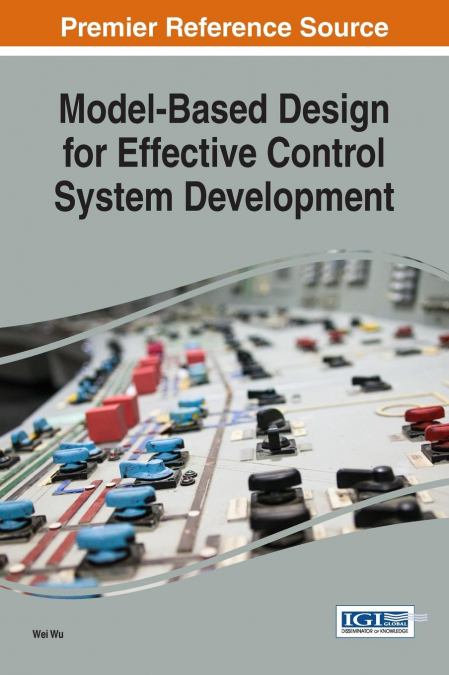
  • Model-Based Design for Effective Control System Development
    Wei Wu
    Control systems are an integral aspect of modern society and exist across numerous domains and applications. As technology advances more and more, the complexity of such systems continues to increase exponentially. Model-Based Design for Effective Control System Development is a critical source of scholarly information on model-centric approaches and implementations for control...
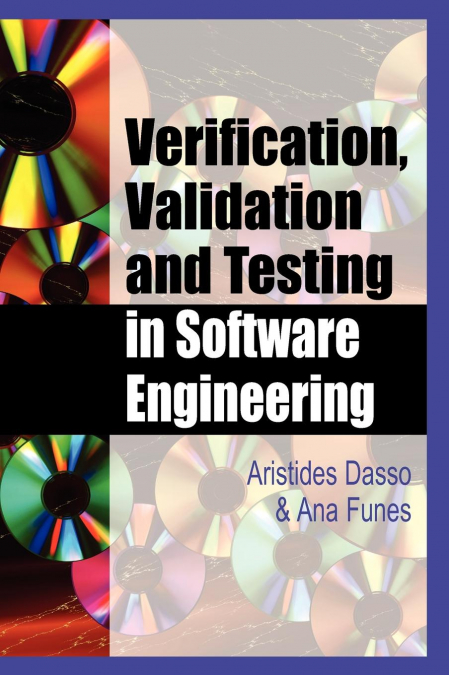
  • Verification, Validation and Testing in Software Engineering
    ...