 Librería Samer Atenea
 Kálamo Books
 Librería Elías (Asturias)
 Librería Kolima (Madrid)
 Librería Proteo (Málaga)
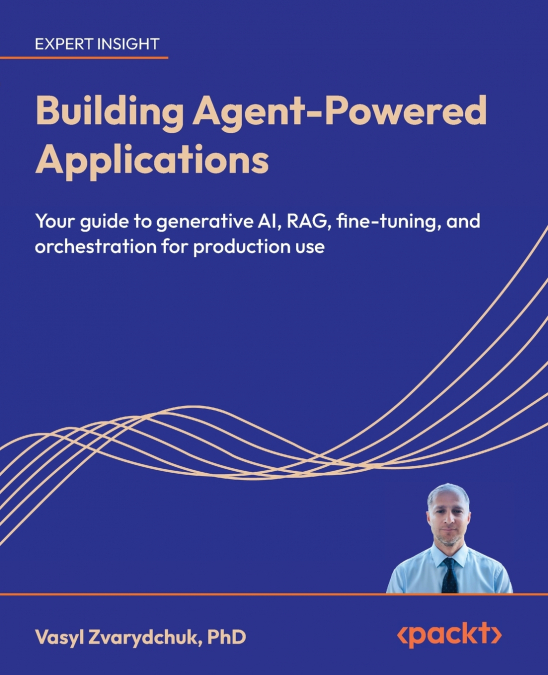
Move from experimentation to real-world deployment with LLM and agentic applications powered by prompting, RAG, fine-tuning, and evaluation.Free with your book: DRM-free PDF version + access to Packt’s next-gen Reader*Key Features:- Design LLM apps by combining prompting, RAG, fine-tuning, and agents- Evaluate reliability, quality, and safety across real-world AI workflows- Build production-ready generative AI systems with practical trade-offs- Purchase of the print or Kindle book includes a free PDF eBookBook Description:Large language models can produce impressive demos, but turning them into reliable products takes more than better prompts. You need to understand model behavior, know when to use retrieval or fine-tuning, structure agents correctly, and evaluate systems before deployment.Building Agent-Powered Applications gives an end-to-end engineering perspective on creating production-ready generative AI solutions. Written by Microsoft Principal AI Engineer Vasyl Zvarydchuk, it helps software engineers, data scientists, and applied AI practitioners move from concept to implementation. You’ll begin with AI, NLP, embeddings, transformers, and LLM behavior, then progress to prompt engineering, summarization, classification, extraction, reasoning, RAG, and fine-tuning.The book shows how to design agentic workflows with tools, memory, planning, orchestration, and human-in-the-loop controls. You’ll learn to evaluate quality with offline and online testing, task-specific metrics, LLM-as-a-judge methods, and responsible AI checks. Rather than treating prompting, RAG, fine-tuning, and agents as separate topics, this book shows how they work together in practice. By the end, you’ll be able to make better architectural trade-offs, reduce failure modes, and build scalable, trustworthy AI applications.*Email sign-up and proof of purchase requiredWhat You Will Learn:- Understand LLMs, transformers, embeddings, and inference- Apply prompt engineering for reliable model behavior- Build RAG pipelines that improve grounding and accuracy- Choose between prompting, RAG, and fine-tuning wisely- Solve NLP tasks from summarization to information extraction- Design AI agents with tools, memory, and planning- Evaluate agents and LLM apps with practical metrics- Deploy robust, scalable, and responsible AI systemsWho this book is for:This book is for AI Engineers, data scientists, software engineers, applied AI practitioners, technical leads, and engineering-focused product managers who want to build production-ready applications with LLMs and AI agents. It suits readers moving from traditional software development or classical machine learning into generative AI systems. You should be comfortable with programming in Python or a similar language and understand core software engineering concepts such as APIs, data structures, and integration. Prior deep learning or LLM training experience is not required.Table of Contents- Artificial Intelligence and Natural Language Processing Fundamentals- Understanding Large Language Models- Prompt Engineering- Understanding Language Tasks- Generation, Question Answering, and Reasoning- Retrieval-Augmented Generation- LLM Fine-Tuning- Exploring the Architecture of AI Agents- Building AI Agents- Evaluating LLM Applications and Agents