

 Librería Samer Atenea
 Kálamo Books
 Librería Elías (Asturias)
 Librería Kolima (Madrid)
 Librería Proteo (Málaga)
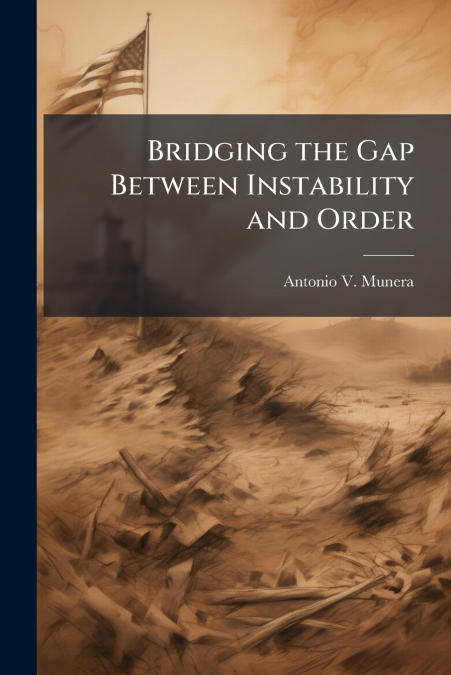
The United States is engaged in a long war. And although U.S. military forces today dominate the battlefield, victory is not achieved through the traditional annihilation of enemy forces. Today, the United States achieves victory through the quiet synchronization and integration of all elements of national power to win the peace in the aftermath of military intervention. Winning the peace requires the United States to shift from a 20th century annihilation approach to a full spectrum approach that enables the military to employ forces to respond to the entire continuum of the irregular nature of warfare today. While the ability to impose conventional solutions remains important, the ability to restore security, rule of law and rebuild civil society in the aftermath of conflict is just as important. This focus on restoring the infrastructure of a former adversarial state or region in the aftermath of conflict or Stability and Reconstruction Operations (SRO) is now a fundamental ingredient to achieving strategic victory and winning the peace in the 21st century. Current operations in Kosovo, Afghanistan and Iraq provide poignant examples of the future nature of warfare. However, despite the renewed emphasis on interventions in countries or regions to restore or bolster legitimate governments, deal with the aftermath or the disposal of illegitimate ones, and respond to domestic and international disaster relief efforts, SRO are not new. Throughout its history, the U.S. military conducted SRO in the aftermath of conflict. Prime examples include restoring the South after the American Civil War, operations in the Caribbean and the Philippines at the turn of the 20th century, post-World War II occupations of Germany and Japan, and more recent stability operations in Haiti, Somalia and Bosnia. Success in historical and current operations hinges on the ability of the United States and coalition partners to fill the security gap and set the conditions for the transition of sThis work has been selected by scholars as being culturally important, and is part of the knowledge base of civilization as we know it. This work was reproduced from the original artifact, and remains as true to the original work as possible. Therefore, you will see the original copyright references, library stamps (as most of these works have been housed in our most important libraries around the world), and other notations in the work.This work is in the public domain in the United States of America, and possibly other nations. Within the United States, you may freely copy and distribute this work, as no entity (individual or corporate) has a copyright on the body of the work.As a reproduction of a historical artifact, this work may contain missing or blurred pages, poor pictures, errant marks, etc. Scholars believe, and we concur, that this work is important enough to be preserved, reproduced, and made generally available to the public. We appreciate your support of the preservation process, and thank you for being an important part of keeping this knowledge alive and relevant.





