 Librería Samer Atenea
 Kálamo Books
 Librería Elías (Asturias)
 Librería Kolima (Madrid)
 Librería Proteo (Málaga)
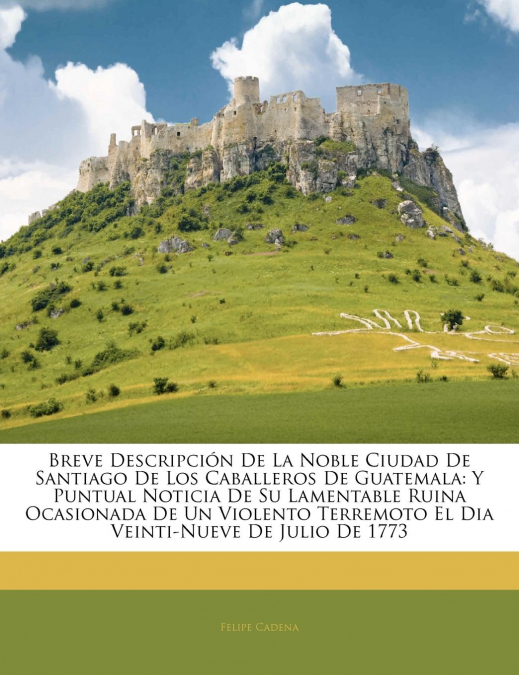
A detailed account of the noble city of Santiago de los Caballeros de Guatemala and the devastating earthquake of July 29, 1773. 'Breve Descripción De La Noble Ciudad De Santiago De Los Caballeros De Guatemala Y Puntual Noticia De Su Lamentable Ruina Ocasionada De Un Violento Terremoto El Dia Veinti-Nueve De Julio De 1773' offers a historical perspective on the city’s architecture, culture, and the impact of natural disasters. This work provides invaluable insights into the social and physical landscape of colonial Guatemala, capturing a pivotal moment in its history. Felipe Cadena’s narrative serves as a primary source for understanding the challenges faced by the city’s inhabitants and the subsequent efforts to rebuild and preserve its legacy. A significant resource for historians, architects, and anyone interested in the rich history of Central America.This work has been selected by scholars as being culturally important, and is part of the knowledge base of civilization as we know it. This work was reproduced from the original artifact, and remains as true to the original work as possible. Therefore, you will see the original copyright references, library stamps (as most of these works have been housed in our most important libraries around the world), and other notations in the work.This work is in the public domain in the United States of America, and possibly other nations. Within the United States, you may freely copy and distribute this work, as no entity (individual or corporate) has a copyright on the body of the work.As a reproduction of a historical artifact, this work may contain missing or blurred pages, poor pictures, errant marks, etc. Scholars believe, and we concur, that this work is important enough to be preserved, reproduced, and made generally available to the public. We appreciate your support of the preservation process, and thank you for being an important part of keeping this knowledge alive and relevant.