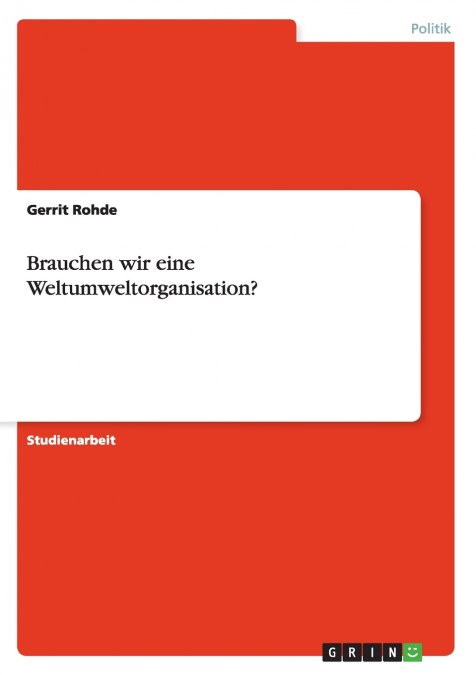

Brauchen wir eine Weltumweltorganisation?

Brauchen wir eine Weltumweltorganisation?

Gerrit Rohde

20,04 €
IVA incluido
Disponible
Editorial:
GRIN Verlag
Año de edición:
2010
Materia
Relaciones internacionales
ISBN:
9783640504985
20,04 €
IVA incluido
Disponible

Selecciona una librería:

  • Librería Samer Atenea
  • Librería Aciertas (Toledo)
  • Kálamo Books
  • Librería Perelló (Valencia)
  • Librería Elías (Asturias)
  • Donde los libros
  • Librería Kolima (Madrid)
  • Librería Proteo (Málaga)

Studienarbeit aus dem Jahr 2005 im Fachbereich Politik - Thema: Internationale Organisationen, Note: 2,0, Universität Hamburg (Institut für politische Wissenschaft), Veranstaltung: Grundkurs Entwicklungstheorien und Entwicklungspolitik, Sprache: Deutsch, Abstract: Die institutionelle Zersplitterung in der globalen Umweltpolitik ist so ausgeprägt wie in keinem anderen Politikfeld. Bi- oder multilaterale Abkommen zwischen zwei oder mehreren Staaten beschränken sich meist auf die sektorale Bearbeitung spezifischer Umweltprobleme. Dabei können einerseits Reibungsverluste zwischen verschiedenen Abkommen, die sich der Bearbeitung eines Problemfeldes widmen, anderseits Zielkonflikte zwischen den einzelnen Problemfeldern entstehen. Zur Lösung dieser Probleme plädieren einige Politiker und Wissenschaftler für die Gründung einer neuen politischen Körperschaft, die bestehende Regime in sich eingliedert und als institutionelle Dachorganisation auftritt. Die deutsche Bundesregierung ließ durch ihre umweltpolitische Sprecherin am 25. Januar 1999 verlauten: „Wir brauchen [...] eine Bündelung der unübersichtlichen und zersplitterten internationalen Institutionen und Programme'. In der wissenschaftlichen Forschungsdebatte gibt es Befürworter einer solchen Entwicklung, die in einer institutionellen Bearbeitung globaler Umweltprobleme gemäß der politischen Idee „Global Governance' die optimale Lösung sehen. Bei der möglichen Ausgestaltung einer Weltumweltorganisation reichen die Forderung von einer hierarchischen Organisation, nach Vorbild des Weltsicherheitsrat bis zu einer Organisation, die lediglich mit weichen Durchsetzungsmechanismen ausgestattet ist und vornehmlich Informationsstandards einführt, aber keinerlei Sanktionsgewalt besitzt (Biermann und Simonis: 2000).Andere Wissenschaftler sehen keinerlei Zusatznutzen in der Aufhebung der institutionellen Zersplitterung und beschäftigen sich zunächst mit den Ursachen dieser Entwicklung. Ist die sektorale Zersplitterung in der global

Artículos relacionados

  • Realism in Practice
    The purpose of this book is to appraise the current relevance and validity of realism as an interpretative tool in contemporary International Relations. All chapters of the book are animated by a theoretical effort to define the conceptual aspects of realism and attempt to establish whether the tradition still provides the necessary conceptual tools to scholars.The chapters add...
    Disponible

    20,36 €

  • Predicting gender violence in India
    Shritha K Vasudevan
    In this provocative new book, Shritha Vasudevan argues that feminist international relations (IR) theory has inadvertently resulted in a biased worldview, the very opposite of what feminist IR set out to try to rectify. This book contests theoretical presumptions of Western feminist IR and attempts to reformulate it in contexts of non-Western cultures. Vasudevan deftly utilizes...
  • Contemporary security issues in Africa
    Isiaka Alani Badmus / Lere Amusan
    In volume, an emerging generation of African scholars examines specific states in Africa where instability is the order of the day. Considerations of African instability are highly relevant in today’s world, where one examines the types of regimes that were put in place after the Cold War and their effects on Africa. Multiparty systems introduced in Africa, rather than bringing...
  • Chronicles of the first and second chechen wars
    Ilya Milyukov
    Presented by Russian author and attorney Ilya Milyukov, Chronicles of the First and Second Chechen War presents the main events of the First (1994-1996) and Second (1999-2009) Wars in Chechnya, Russia’s deadliest conflicts since World War II. The First War began in December 1994 and lasted for one year and nine months, ending in August 1996. There were two major urban battles -...
  • Political instability in Africa
    Isiaka Alani Badmus / Lere Amusan
    This book offers broad-gauged analyses of the causes, nature, and changing patterns of armed conflict in Africa as well as the reasons for these patterns. It also situates conflicts that have been haunting the African continent since the time of decolonization within the various theoretical schools such as 'new war,' 'economic war,' 'neo-patrimonial,' and 'globalization.' It be...
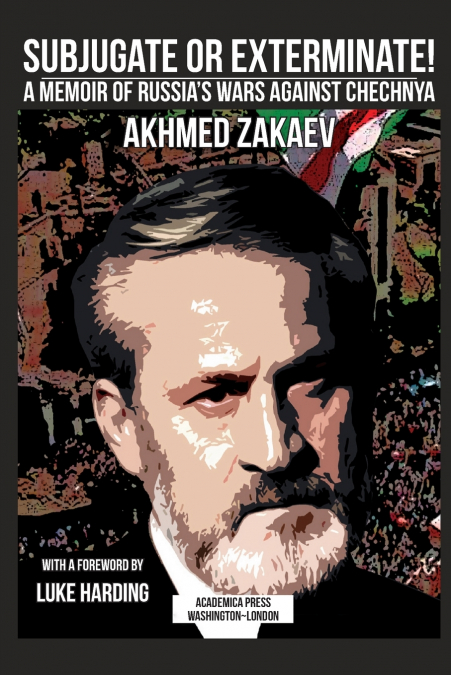
  • Subjugate or exterminate!
    Akhmed Zakaev / Arch Tait
    Foreword by Luke HardingAkhmed Zakaev is a symbol of the indomitable will of the Chechen nation. In this important memoir, he tells the story of the Chechen struggle as he experienced it, describing the conflict in human terms and providing a detailed documentary record of little known or badly understood events that will be of benefit to historians for generations to come.- Da...
    Disponible

    41,63 €