 Librería Samer Atenea
 Kálamo Books
 Librería Elías (Asturias)
 Librería Kolima (Madrid)
 Librería Proteo (Málaga)
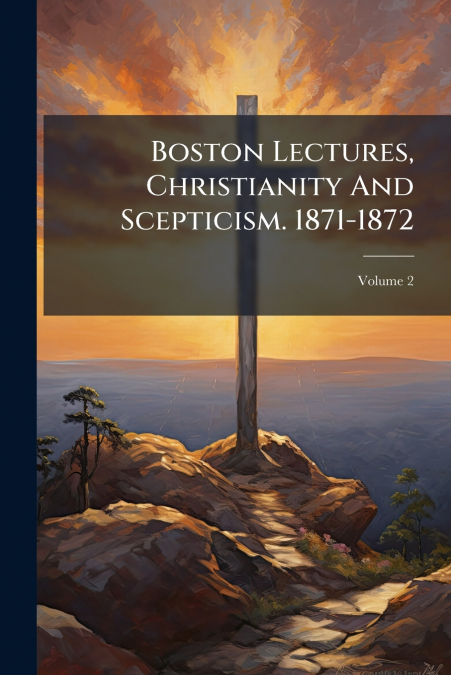
Boston Lectures, Christianity and Scepticism, 1871-1872, Volume 2 presents a series of lectures exploring the complex relationship between Christian faith and the rising tide of skepticism during the late 19th century. Addressed to an educated audience, the lectures engage with contemporary scientific advancements and philosophical inquiries that challenged traditional religious beliefs. The contributors, while remaining anonymous, represent a cross-section of theological perspectives. They offer reasoned arguments and considered responses to the doubts and questions raised by modern thought. This volume captures a pivotal moment in intellectual history, reflecting the debates and tensions that shaped the ongoing dialogue between religion and science. It provides valuable insight into the historical context of these discussions and the enduring questions that continue to resonate today. A must-read for anyone interested in the history of Christian thought, the development of skeptical inquiry, or the intersection of faith and reason.This work has been selected by scholars as being culturally important, and is part of the knowledge base of civilization as we know it. This work was reproduced from the original artifact, and remains as true to the original work as possible. Therefore, you will see the original copyright references, library stamps (as most of these works have been housed in our most important libraries around the world), and other notations in the work.This work is in the public domain in the United States of America, and possibly other nations. Within the United States, you may freely copy and distribute this work, as no entity (individual or corporate) has a copyright on the body of the work.As a reproduction of a historical artifact, this work may contain missing or blurred pages, poor pictures, errant marks, etc. Scholars believe, and we concur, that this work is important enough to be preserved, reproduced, and made generally available to the public. We appreciate your support of the preservation process, and thank you for being an important part of keeping this knowledge alive and relevant.