

 Librería Samer Atenea
 Kálamo Books
 Librería Elías (Asturias)
 Librería Kolima (Madrid)
 Librería Proteo (Málaga)
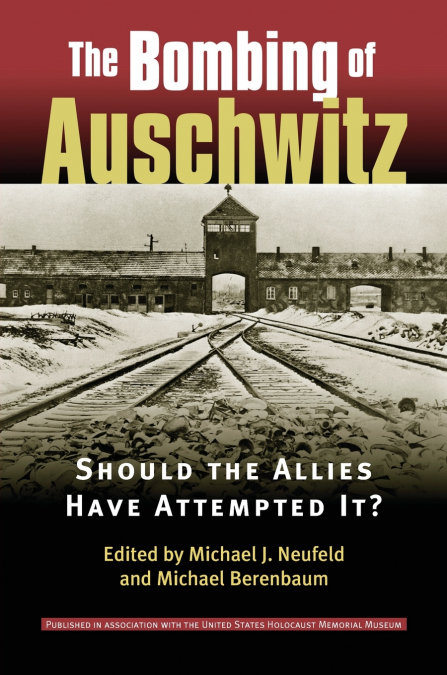
Did we 'know' the gas chambers were there? Could we have destroyed them? Why didn’t we bomb? For decades, debate has raged over whether the Allies should have bombed the gas chambers at Auschwitz and the railroads leading to the camp, thereby saving thousands of lives and disrupting Nazi efforts to exterminated European Jews. Was it truly feasible to do so? did failure to do so simply reflect a callous indifference to the plight of the Jews or was it a realistic assessment of a plan that could not succeed? In this volume, a number of eminent historians address and debate those very questions. Published in association with the United States Holocaust Memorial Museum, this is the first paperback edition of a book that has been widely hailed by critics and cited by Kirkus Reviews as 'the definitive resource for understanding this deeply troubling episode in the twentieth century’s greatest horror.' Prominent scholars such as Sir Martin Gilbert, Walter Laqueur, Michael Berenbaum, Gerhard Weinberg, and Williamson Murrag offer a diverse array of mutually supporting and competing perspectives on the subject. In the process, they shed important light on how much knowledge of Auschwitz Allied intelligence actually had and on what measures the Allies might have taken to halt the killing. The book is also rich in documentary evidence--including the correspondence of Churchill, Roosevelt, Cordell Hull, Anthony Eden, and John McCloy--that reveals just how much these men knew about the situation and what they thought about its potential resolution. It also includes a selection of the most important documents and aerial reconnaissance photos from 1944 exploring the feasibility of an air strike. Ultimately, these contributions show that the dilemma over Auschwitz was far more complex than criticisms of inaction would suggest. The Bombing of Auschwitz is an unusual volume that confronts life-and-death questions and addresses a matter of enduring interest for all readers of World War II and Holocaust history.Introduction to the Controversy, Michael J. NeufeldI. Allied Knowledge and Capabilities1. The Allies and the Holocaust, Gerhard L. Weinberg2. Auschwitz Partially Decoded, Richard Breitman3. Allied Air Power: Objectives and Capabilities, Tami Davis Biddle4. The Aerial Photos of the Auschwitz-Birkenau Extermination Complex, Dino A. BrugioniII. Bombing Auschwitz: For and Against5. The Contemporary Case for the Feasibility of Bombing Auschwitz, Martin Gilbert6. The Allies and Auschwitz: A Participant’s View, Gerhart M. Riegner7. The Bombing of Auschwitz Re-Examined, James H. Kitchens III8. The Bombing of Auschwitz Revisited: A Critical Analysis, Richard H. Levy9. Could the Allies Have Bombed Auschwitz-Birkenau?, Stuart G. Erdheim10. Bombing Auschwitz: U. S. Fifteenth Air Force and the Military Aspects of a Possible Attack, Rondall R. RiceIII. New Perspectives on the Controversy11. Auschwitz, Walter Laquer12. Bombing Auschwitz and the Politics of the Jewish Question During World War II, Henry L. Feingold13. Monday-Morning Quarterbacking and the Bombing of Auschwitz, Williamson Murray14. The Bombing of Auschwitz: Comments on a Historical Speculation, Richard G. Davis15. The Failure to Rescue and Contemporary American Jewish Historiography of the Holocaust: Judging from a Distance, Deborah E. LipstadtIV. Documents1. Preliminaries2. The First Appeals to the Americans3. The Appeal to the British4. The Later Appeals to the AmericansNotesSelect BibliographyIndex





