
Inicio > Derecho > Derecho internacional > Boko Haram and International Law
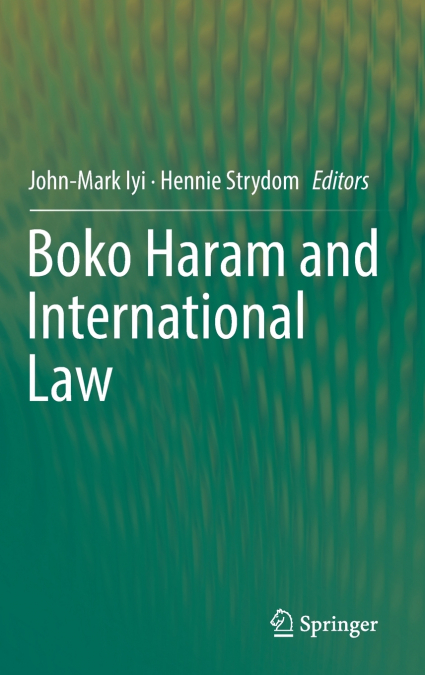
Boko Haram and International Law

Boko Haram and International Law


267,05 €
IVA incluido
Consulta disponibilidad
Editorial:
Springer Nature B.V.
Año de edición:
2018
Materia
Derecho internacional
ISBN:
9783319749556

Selecciona una librería:

  • Librería Samer Atenea
  • Librería Aciertas (Toledo)
  • Kálamo Books
  • Librería Perelló (Valencia)
  • Librería Elías (Asturias)
  • Donde los libros
  • Librería Kolima (Madrid)
  • Librería Proteo (Málaga)

This book focuses on Boko Haram and terrorism in Nigeria, framing the conflict in an international law context. It analyses the nature of political violence and the dominant roles of a violent nation-state (in both colonial and post-colonial experiences) and the rise of terrorism in Nigeria. The book unearths embedded evidence of religious nepotism on the part of state officials using such state institutions as Islamic Preaching Boards to promote one Islamic sect over another in mainly Muslim Northern Nigeria. The book offers insights into this subtle sectarian divide and how this and other ’subterranean’ elements have contributed to the rise of Boko Haram in Northern Nigeria beyond the dominant poverty-terrorism nexus narrative. Furthermore, the book analyses the various components of Boko Haram’s radical ideology, situates them in Islamic Jurisprudence, and examines the philosophy of the group (both in doctrine and practice) - their interpretation of the Koran and the waging of Jihad, and the extent to which they conform to the Islamic Sect Boko Haram claims to follow. The book then examines the basic doctrinal features and characteristics of Boko Haram - waging Jihad, prohibiting revealing dresses for women and mixing of genders, rejecting western values and institutions, denouncing scientific inquiry and democracy, hostage taking, sexual exploitation of captives and other aspects of jus ad bellum and jus in bello in Islamic jurisprudence and international law. Finally, the book analyses the plight of vulnerable groups such as internally displaced persons, the atrocities committed against women and girls in the Boko Haram insurgency and the (in)ability of international law to enforce the protections offered to the victims. From the perspective of critical intellectual inquiry, the book also challenges a number of fundamental assumptions and encourages us to revisit our legal characterisation of certain concepts such as 'gender-based crimes'. It then goes further to analyse some legal grey areas in the Boko Haram insurgency such as the legal status of the Civilian Joint Task Force (CJTF) and the legal framework for holding members accountable for violations of international human rights and humanitarian law. Overall, the book represents a valuable contribution to scholarship, deepens our understanding and delineates how international law could respond to the Boko Haram insurgency in Nigeria in particular and terrorism in Africa in general.
Artículos relacionados

  • Comparative regulation, economic analysis, and applications of private equity in the united states and european union
    Irini Liakopoulou
    The present work examines the economics and legal doctrine of private equity. After a consideration of private equity’s origins, the book will explore the evolution of private equity in the United States and Europe. The reference economic model then will be reconstructed, with particular attention to financial flows to and from private equity firms and funds. This reconstructio...
  • Complicity in International Law
    Dimitris Liakopoulous
    Complicity in International Law aims to analyze questions arising from a state’s complicity in conflict with another state or an international organization. On the basis of international legal provisions, a state that assists the illicit fact of another state or an international organization in turn commits an offense if it is aware of the main fact and is bound by the same obl...
  • Command responsibility
    James B Whisker / Kevin R Spiker
    Command responsibility, or executive accountability, assumes that leaders are responsible for the actions of their subordinates. If subordinates misbehave, violate basic moral laws, transgress international law, or thwart international standards of behavior, their leader may be called before to justice. Standards that set the boundaries of human action have been evolving for ma...
  • International Organizations and Reparations
    Dimitris Liakopoulos
    In the first part of this book, noted legal scholar Dimtris Liakopoulos deals with reconstructing the legal regulatory framework governing human rights violations in the activities of organizations. After identifying rules that are generally applicable to organizations’ offenses and govern the profile of reparations, this study assesses primary rules that guarantee the right to...
  • International Organizations and Legal Sanctions Against Governments
    Dimitris Liakopoulos
    This book examines the relationship between governments and international organizations under international law. After surveying the policing powers of international organizations under international law, it illustrates some normative aspects of law that distinguish regulation from enforcement via study of recent legal cases before international judicial bodies. According to Di...
  • The EU Foreign Subsidies Regulation
    Andreas Reindl / Isabelle Van Damme
    'The EU Foreign Subsidies Regulation' is a pioneering manual authored by legal experts Andreas Reindl and Isabelle Van Damme. This essential guide, the first of its kind, is tailored for legal practitioners, offering a thorough exploration of the tools and mechanisms embedded within this novel European regulatory framework. The authors meticulously dissect the EU Foreign Subsid...