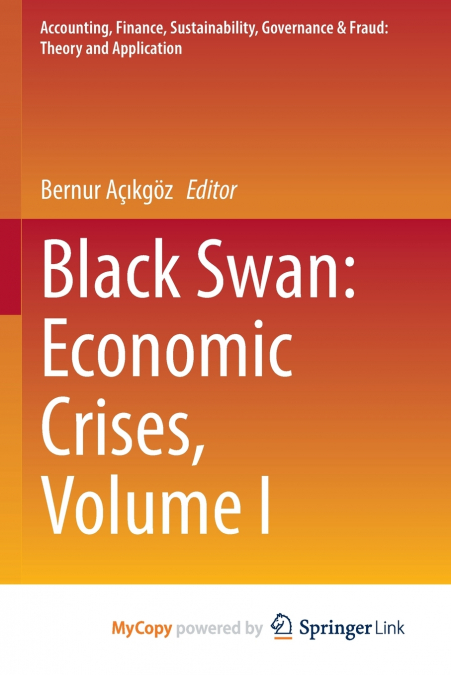

Black Swan

Black Swan

Bernur Açikgöz

208,30 €
IVA incluido
Consulta disponibilidad
Editorial:
Springer Nature B.V.
Año de edición:
2023
Materia
Hacienda pública
ISBN:
9789819923175

Selecciona una librería:

  • Librería Samer Atenea
  • Librería Aciertas (Toledo)
  • Kálamo Books
  • Librería Perelló (Valencia)
  • Librería Elías (Asturias)
  • Donde los libros
  • Librería Kolima (Madrid)
  • Librería Proteo (Málaga)

This book continues the discussion from Volume I on economic, fiscal, and financial crises in world history that have had a great impact on the entire world and the fiscal measures taken by governments to combat each crisis. Such events are often described as black swans, a concept introduced by Economist and Risk Analyst Nassim Nicholas Taleb in the book Fooled By Randomness in 2001, in reference to events that were thought to be impossible but had a huge impact when they did happen.The beginning of this book notes that crises are catastrophic periods when the consequences of economic mistakes made by governments are reflected to the public. Although economic crises are seen as opportunities in some cases, they have created a burden for the people. Some economic crises even triggered the world war. A recent example, Adolf Hitler, was seen as a hope of salvation in Germany due to the Great Depression and was brought to power.The twentieth century, when two great world wars took place on the stage of history, is the witness of major economic crises as well as wars. These crises have caused social and economic paradigm shifts to be experienced much faster and more effectively than the previous centuries. The transformation of the demand-oriented economic understanding created by the Great Depression in 1929 into an interventionist social state understanding, especially after the World War Two, increased the intervention of states in the socioeconomic field. In this period, the reconstruction of the countries, the development of social welfare services, the assurance of human rights, the acceleration of industrialization and development, and the economic growth and income growth of the countries resulted in the golden age enjoyed by the societies of the period.The interventionist social state, seen as a prescription and opportunity in the past crisis, was one of the cornerstones of the crisis in the last quarter of the century in the 1970s. Against interventionism, with the rise of neo-liberalism, financial liberalization, information society, and technological discoveries, globalization has become the new phenomenon of the age. This book examines in detail the causes, occurrences, and results of the twentieth-century crises.

Artículos relacionados

  • The Federal Estate Tax
    David Joulfaian
    ...
    Disponible

    39,16 €

  • Teoría de la Administración Pública
    Jorge Mendoza Vester
    La mayoría de los textos de administración se inclinan hacia una orientación empresarial, centrados en el sector privado. Esta tendencia deja un hueco considerable en la educación de aquellos que aspiran a servir en el sector público. Mi objetivo con este manual es ofrecer una perspectiva que aborde de manera integral los desafíos y particularidades de la administración pública...
    Disponible

    30,71 €

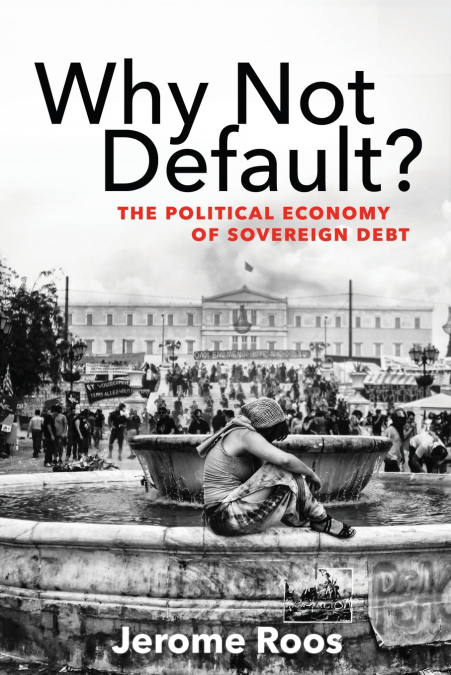
  • Why Not Default?
    Jerome E. Roos
    How creditors came to wield unprecedented power over heavily indebted countries-and the dangers this poses to democracyThe European debt crisis has rekindled long-standing debates about the power of finance and the fraught relationship between capitalism and democracy in a globalized world. Why Not Default? unravels a striking puzzle at the heart of these debates-why, despite f...
    Disponible

    39,81 €

  • Political Economy for Public Policy
    Ethan Bueno de Mesquita
    The ideal introductory textbook to the politics of the policymaking processThis textbook uses modern political economy to introduce students of political science, government, economics, and public policy to the politics of the policymaking process. The book’s distinct political economy approach has two virtues. By developing general principles for thinking about policymaking, i...
  • What Do We Know and What Should We Do About Tax Justice?
    Alex Cobham
    ...
  • Decoding Tomorrow’s Currency
    Randy Woodrum
    'Decoding Tomorrow’s Currency: An In-Depth Exploration of the Future of Cryptocurrency' is an illuminating journey into the multifaceted world of digital currencies and blockchain technologies. This comprehensive exploration examines the origins and evolution of cryptocurrency, unraveling its intricate technological underpinnings and tracing the emergence of groundbreaking conc...
    Disponible

    14,27 €

Otros libros del autor

  • Black Swan
    Bernur Açıkgöz
    This book continues the discussion from Volume I and Volume II on economic, fiscal and financial crises in world history that have had a great impact on the entire world and the fiscal measures taken by governments to combat each crisis. Such events are often described as Black Swans, a concept introduced by economist and risk analyst Nassim Nicholas Taleb in the book Fooled By...
  • Black Swan
    Bernur Açikgöz
    This book presents to the reader the economic, fiscal and financial crises in world history that have had a great impact on the entire world and the fiscal measures taken by governments to combat each crisis since the 1600s in chronological order. Such events are often described as Black Swans, a concept introduced by economist and risk analyst Nassim Nicholas Taleb in the book...
  • Black Swan
    Bernur Açikgöz
    This book presents to the reader the economic, fiscal and financial crises in world history that have had a great impact on the entire world and the fiscal measures taken by governments to combat each crisis since the 1600s in chronological order. Such events are often described as Black Swans, a concept introduced by economist and risk analyst Nassim Nicholas Taleb in the book...
    Disponible

    48,70 €