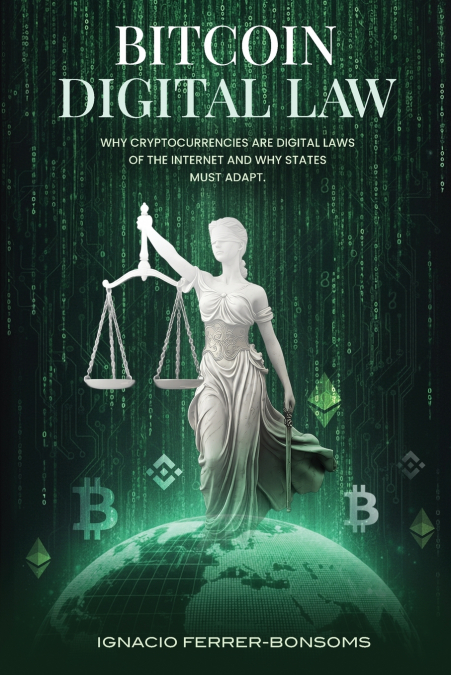
Bitcoin Digital Law

Bitcoin Digital Law

Ignacio José Ferrer-Bonsoms Hernández

9,71 €
IVA incluido
Disponible
Editorial:
The Books Central
Año de edición:
2026
Materia
Teoría general del derecho
ISBN:
9791399037326
9,71 €
IVA incluido
Disponible

Selecciona una librería:

  • Librería Samer Atenea
  • Kálamo Books
  • Librería Elías (Asturias)
  • Librería Kolima (Madrid)
  • Librería Proteo (Málaga)

Bitcoin, Ethereum, Uniswap or Tether are not just digitals currencies. Bitcoin is pure law. Since the emergence of the blockchain, it is possible to regulate ourselves in a decentralized, private way, with a law that is digital, self-regulating and self-executing. Likewise, states, elites and official organizations repeat over and over again the same message from various platforms: Bitcoin is unregulated, it is only good for dirty business, it is merely speculative, etc. While we listen to these slogans, the price of Bitcoin continues to rise, unstoppable. We are witnessing the birth of a new law: internet law. Every era has its own legal system. Property law arose out of the settlement of agricultural societies. Commercial law was born in the Middle Ages. Corporate law flourished in the 17th century, thanks to the maritime mercantile business. Labour law appeared among the assembly lines of the factories of the Industrial Revolution. Digital laws, such as Bitcoin, are those of internet jurisdiction. Internet technology allows us to be sovereign, to issue digital laws in a decentralized way, and to organize ourselves through new institutions. It is our responsibility to seek social and legal solutions in line with the internet revolution. This is the message that Bitcoin gives us: let’s not leave in the hands of distrustful third parties what we can solve from the community itself. Money and law, in the end, belong to society - to the community - and not to states.
Artículos relacionados

  • EU General Data Protection Regulation (GDPR)
    IT Governance Privacy Team
    An in-depth guide to complying with the EU GDPR.Now in its second edition, EU GDPR – An Implementation and Compliance Guide is a clear and comprehensive guide to this new data protection law, providing a detailed commentary on the Regulation, and setting out the obligations of data  processors and controllers in clear and comprehensible terms.Read this book to learn: How the ...
    Disponible

    30,10 €

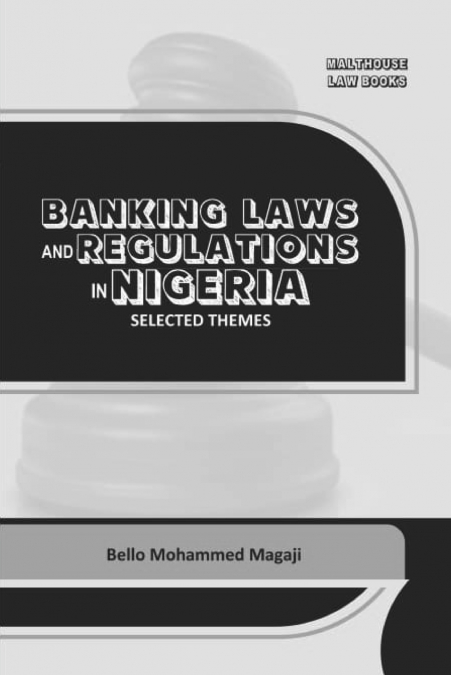
  • Banking Laws and Regulations in Nigeria
    Bello Mohammed Magaji
    Banking Law and Regulations in Nigeria: Selected Themes essentially deals with the laid down rules or code of conduct meant to control and set standards for banking business. Indeed, the main aim of the ongoing banking reforms in Nigeria, started in 2004, is to ensure banks’ conformity to the laid down banking rules and regulations. The eleven-chapter book contains vital and ri...
    Disponible

    41,17 €

  • States and the Interpretation of Treaties
    Dimitris Liakopoulos
    States and the Interpretation of Treaties opens with a provocative reconsideration of a debate on the subject of comparative international legal obligations by the United Nations’s International Law Commission. In this book, distinguished Tufts University legal scholar Dimitris Liakopoulos identifies and explores relevant considerations in the work of the Commission and offers ...
  • The role of customs in international treaties
    Dimitris Liakopoulos
    The Role of Customs in International Treaties concentrates on issues of friction between member states of the United Nations. In view of the role played by the United Nations in resolving international disputes, Dimitris Liakopoulos hypothesizes that 'practical guides' based on custom often catalyze the positions taken by states, courts, scholars, and other actors, constituting...
  • Debtor protection in American and European Union bankruptcy law
    Dimitris Liakopoulos
    In Debtor Protection in American and European Union Bankruptcy Law, international law scholar Dimitris Liakopulos raises a delicate issue at the foundations of the modern banking system by analyzing US bankruptcy law with a focus on the concept of automatic stay. His work identifies legal sources and authorities having repercussions in terms of operational protection. It then e...
  • Capital punishment in American courts
    James Biser Whisker / Kevin Spiker
    In the 400 years since the first known execution was carried out for treason in Virginia, American jurisdictions have debated both the appropriateness and methods of capital punishment. Over that time, courts have placed varying restrictions on its application, excluding categories of citizens (for example the insane or the underaged) and evaluating and excluding methods of exe...